

The U.S. military’s controlled detonation of 68 barrels of unstable lead azide in Iowa on Wednesday is expected to produce a plume of dust containing lead particles that could extend up to 100 miles away, a plan that residents, lawmakers and environmental groups say has not been adequately communicated.
The date of the detonation at the Iowa Army Ammunition Plant in Middletown, Iowa, has changed several times following legal challenges, which argue in part that the government failed to adequately warn local communities of environmental and health risks.
Lead is a toxic metal that can cause serious health problems, especially in children and pregnant people. No exposure to lead is safe, according to the Centers for Disease Control and Prevention.
Support free and independent journalism. Join the PBS News Press Pass
Originally scheduled for Friday, November 20, the detonation was initially postponed until Monday, when the military said the event could take place before falling temperatures threatened to further destabilize the degrading lead azide.
A federal appeals court on Friday temporarily suspended the military’s authorization for the detonation as a federal judge considers a lawsuit filed by environmental groups seeking to block the blast.
The Justice Department said the military was invoking its emergency powers that allow it to carry out the explosion without authorization from the Environmental Protection Agency.
LEARN MORE: The U.S. military plans to invoke emergency provisions to detonate bomb-making chemicals in Iowa.
On Sunday evening, the army announced its decision to carry out the detonation, postponed again until Wednesday.
But President Donald Trump said Monday that he had ordered the military not to carry out the detonation without court approval. Trump said the decision would be submitted to the courts and to Iowa’s new Democratic governor, Rob Sand, although he does not take office until January 12, 2027.
LEARN MORE: Trump says military won’t detonate bomb-making chemicals in Iowa without court approval
“If he or the courts disagree, we will have no choice but to not proceed with the controlled disposal of these hazardous materials and will be forced to hold the new governor accountable for any death or destruction caused by this very unfortunate and long-term situation,” Trump said in a Truth Social article.
To prepare for the detonation, Iowa Republican Gov. Kim Reynolds activated a state emergency operations center on Nov. 20 and created a website with information. The Federal Aviation Administration restricted flights in the region between Monday and Wednesday.
Here’s what you need to know about lead azide, the expected explosion, and safety precautions.
What is lead azide and why is the military saying it has to detonate the Iowa stockpiles?
Lead azide is a very volatile explosive agent. It is used to launch ammunition.
The Army said it discovered the stockpile of degraded and crystallized lead azide during a March safety examination at the Iowa Army Ammunition Plant. When lead azide crystallizes, it becomes sensitive to temperature changes, shock, and friction, making it dangerous to move around because it can explode.
It is unclear why the Army did not dispose of the lead azide barrels before they deteriorated.
In his Truth Social article, Trump blamed the Obama administration, saying it had “inappropriately stockpiled a large number of explosives” in 2009. However, Iowa Public Radio reported that the military launched an explosives project in 2004 due to concerns about the deterioration of a 40-year-old stockpile of lead azide at the Iowa plant. George W. Bush was president at the time.
The Army filed an environmental assessment last September seeking an emergency permit from the EPA that would allow it to detonate 9,500 pounds of lead azide at the Iowa Army Munitions Plant.
In October, the Iowa plant held an open house on its detonation plan for Middletown residents. The EPA granted the permit on November 13, and it will expire on February 11, 2027. On November 15, the Army announced that it had scheduled two controlled detonations for November 20.

Lt. Col. Daniel Nosse, commander of the Iowa Army Ammunition Plant, joins other subject matter experts to answer questions from residents and city officials regarding the planned controlled detonation of lead azide during an open house at the Armed Forces Reserve Center in Middletown, Iowa, October 15, 2026. Lori McFate/U.S. Army via Reuters
According to the Army’s assessment, controlled detonation at the Iowa plant is the only way to remove the lead azide.
Lead azide cannot be packaged or transported to another facility because it could accidentally explode and harm people handling the material as well as the general public, according to the Army’s Q&A on the explosion.
Chemical neutralization would prevent the dust plume, but it would increase the likelihood of a fatal detonation during handling, according to the Army, because it would require more physical handling of the drums.
The New York Times reported that in March the Army awarded MuniRem Environmental, a company that uses chemicals to neutralize munitions, a contract to remove lead azide. Two months later, she terminated the contract without giving the company a reason for termination.
Environmental groups pursuing the Army’s emergency permit say the Army did not carefully consider other alternatives.
What are the health and environmental risks linked to the detonation of lead azide?
The army plans two detonations to eliminate the lead azide.
Before the explosions were reported, residents in the Middletown City Park and Butterfly Park neighborhood were asked to evacuate Friday from 8 a.m. to 2 p.m. The explosion was planned for noon.
The explosions are expected to potentially shatter windows and cause noise and vibrations on the ground, as well as produce a plume of lead-containing dust, according to the Army public advisory. Residents in the area were advised to temporarily evacuate due to potential window damage.
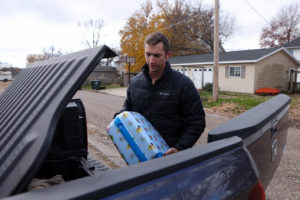
Resident Sean Byers loads his vehicle to evacuate his family, including three young children, from the area as residents plan the U.S. military’s explosion of a degraded stockpile of lead azide in Middletown, Iowa, November 23, 2026. Photo by Jim Urquhart/Reuters
When lead azide explodes, larger lead particles will fall to the ground first; smaller particles will travel further from the detonation site, according to Andrew Whelton, a professor of environmental engineering at Purdue University who has helped communities recover from chemical disasters.
How far lead travels depends on environmental conditions, he said.
David Cwiertny, director of the Center for Health Effects of Environmental Contamination at the University of Iowa, said the direction the wind blows will determine where the plume reaches. He and other researchers monitor lead levels before and after the detonation.
“It really makes it unfair for anyone in these communities who are completely at the mercy of Mother Nature to know whether or not they’re in an area that might get more lead dust deposition,” Cwiertny said.
The Iowa Department of Health and Human Services says the main public health risks from detonations come from exposure to lead in the air and on the surface.
Iowa health officials advise people to stay indoors and keep all windows and doors locked for 24 to 48 hours after the detonation. He also recommends cleaning surfaces with soap and water that may have been affected, including window sills, cars and playgrounds.
What are environmental activists and residents asking for?
Local residents, environmental activists, researchers and public officials have all expressed concerns about the lack of transparency and communication around the planned detonations.
Environmental groups, including the Environmental Council of Iowa, the Sierra Club and Earthjustice, claim in their lawsuit that the military failed to notify people beyond Middletown about the explosions.
Army maps modeling areas where the plume could reach include parts of Illinois, for example. In a Nov. 18 statement, Illinois EPA officials said they had not been notified of the detonation.
Illinois officials noted a lack of transparency about the methods the military used to estimate where the plume would reach and to sample the air after the detonation.
Whelton said transparency around the Army’s modeling and its plans is crucial to keeping people safe.
“This should have happened in advance to avoid confusion,” Whelton said. “Because detonating 10,000 pounds of munitions near a residential area surrounded by all these agricultural businesses has a real psychological and mental impact for a lot of these people.”
It was the lack of clarity from the military that prompted Cwiertny and his colleagues to take oversight into their own hands.
“It became very clear that there was an unclear answer when it came to oversight,” he said.
LEARN MORE: Iowans brace for lead dust cloud as military plans to detonate 5 tons of bomb-making chemicals
He noted a lack of information about where the military would take soil or air samples and what they would measure.
“If it’s something infrequent, you have to be transparent, clear, reassuring. I wouldn’t characterize what’s happening that way,” Cwiertny said. “We talk to people in these communities and it’s just not coming across. These are people who feel like they need to know more and feel like they don’t know anything.”
The lack of communication is not “an indictment of the work they are going to do,” he said. The military’s response could be toned down and controlled. But if that’s not the case, Cwiertny and his colleagues want to prioritize getting information quickly.
By sampling the area, researchers will know where to prioritize cleaning and follow-up health screenings.
“You can’t manage what you don’t measure,” he said.
PBS News senior associate producer Courtney Norris contributed reporting to this story.
A free press is the cornerstone of a healthy democracy.
Support trusted journalism and civil dialogue.
Gn usa