
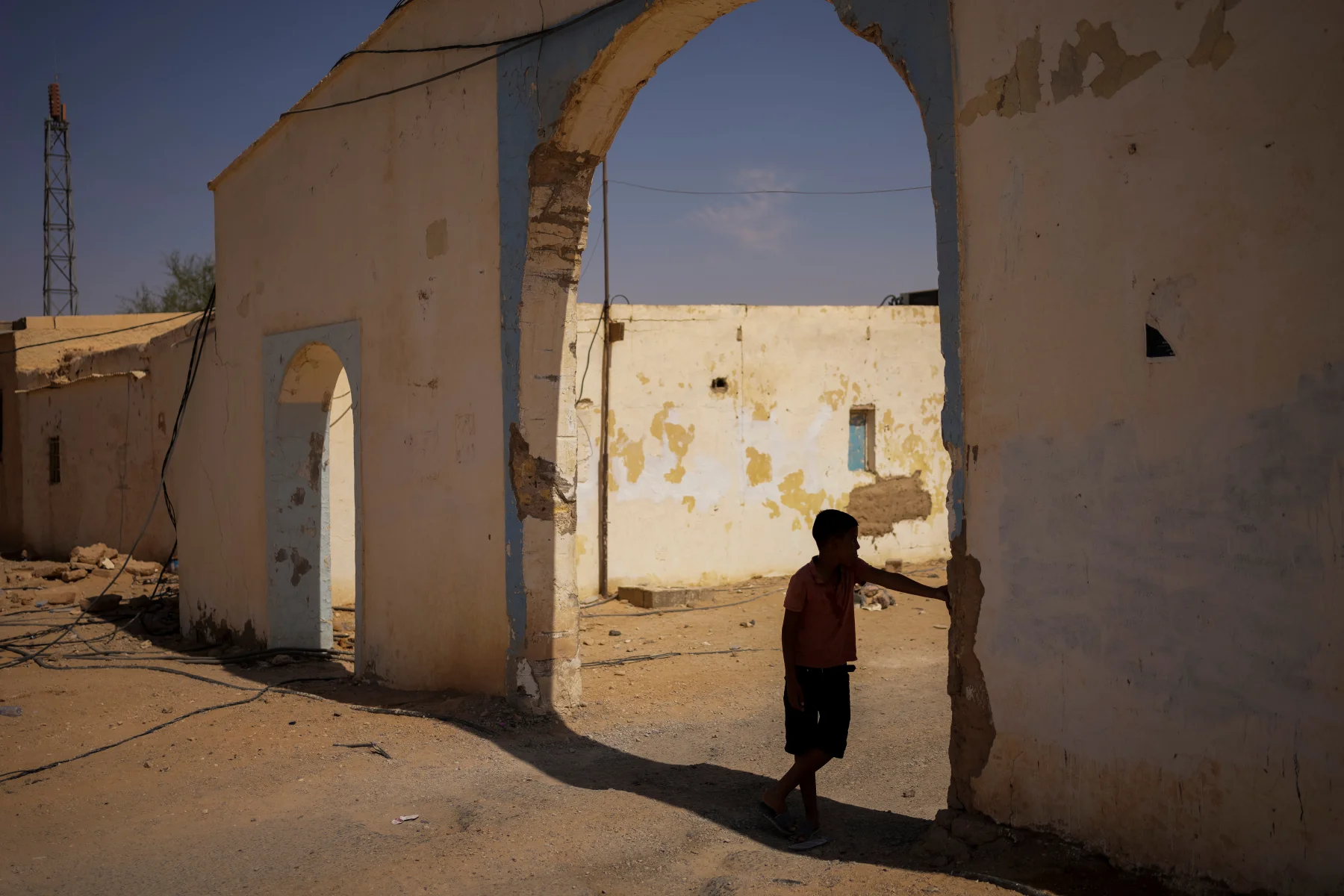
FILE – A Sahrawi refugee boy stands in the shadows of the Boujdour refugee camp, October 11, 2021.
Bernat Armangue/AP
hide caption
Bernat Armangue/AP
CASABLANCA, Morocco — The long-running U.N. peacekeeping mission for disputed Western Sahara ceased operations Sunday after 35 years, following a standoff between the United States and Russia at U.N. headquarters over the territory’s future.
The end of the mission raises concerns about the stability of the region. Rich in minerals and fisheries, Western Sahara is a vast desert territory the size of Colorado along the northwest Atlantic coast of Africa. Formerly governed by Spain, it is claimed by both Morocco and the pro-independence Polisario Front.
“This November 1, 2026 marks the start of the liquidation period,” said Stéphane Dujarric, spokesperson for the UN Secretary-General, in a statement. “A smaller team under the United Nations Department of Operational Support will oversee the orderly transport of assets belonging to troop-contributing countries to their respective countries, as well as the proper disposal of equipment belonging to the United Nations.”
The mission has been extended several times since its creation in 1991. At the U.N. Security Council on Friday, Russia vetoed a draft U.S. resolution that would have supported Morocco’s demand for sovereignty over Western Sahara and ended the peacekeeping mission next year.
Then a rival Russian resolution to extend the mission was rejected. This disagreement led to the abrupt end of the force’s mandate.
The royal palace of Morocco welcomed the non-renewal of the mission. He called it “an instrument intended to internationalize the dispute.”
The Algerian-backed Polisario Front called the move an “unacceptable decision.” The Algerian Foreign Ministry said it deeply regretted the non-renewal of the mandate and criticized what it called the “excessive bias” of the US draft resolution.
Western Sahara is Africa’s longest territorial conflict
The UN classifies Western Sahara as a “non-self-governing territory”, while critics of Moroccan control describe it as Africa’s last colony. Morocco administers almost all of the disputed territory, except for a narrow strip known as the “free zone” that extends east of a Moroccan-built sand wall.
After the annexation of Morocco in 1975, the conflict turned into an armed conflict that lasted more than 15 years and left more than 16,000 dead on both sides, according to the French Senate.
Placing Western Sahara under its full sovereignty has been a central objective of Morocco’s foreign policy for decades. Rabat, which has won support from a growing number of Western capitals, including Washington, Paris and London, refers to the territory as the southern provinces. The dispute has become a defining element of Moroccan diplomacy, with the kingdom often measuring its relations with other countries based on their position on the issue.
The Polisario Front claims the independence of the territory, which it considers to be the homeland of the indigenous Sahrawi people. Operating from refugee camps in the Algerian town of Tindouf, the movement aims to establish an independent Sahrawi Republic. Mainly supported by Algeria, Russia and South Africa, the Polisario has seen its international support dwindle in recent years.
The expired mission was created to monitor a referendum
A UN-brokered ceasefire came into effect in 1991. The agreement also paved the way for the creation of the United Nations Mission for the Referendum in Western Sahara, known as MINURSO.
The settlement plan included a self-determination referendum, with independence among the options. But the vote never took place. Morocco wanted the electoral list to include Sahrawis living in the territory it controls, which the Polisario opposed, arguing that their inclusion would tip the balance towards integration with Morocco. The movement insisted on using the Spanish colonial census to determine voter eligibility.
Twenty MINURSO personnel lost their lives during the mission. The UN force was authorized to number 534 personnel and its 2026-2027 budget was more than $62 million. The main military contributors to the force were Egypt, Ghana and Pakistan.
At the end of the mission, the UN Secretary General “calls on all parties to respect and promote the rights of the people of Western Sahara”, declared Dujarric, and “remains concerned about the security situation throughout the territory and the risk of escalation of hostilities. He calls on all parties concerned to exercise the greatest restraint”.
The Polisario withdrew from the ceasefire in 2020 after clashes and the territory has since remained the scene of low-intensity tensions and hostilities, the UN said last month.
Western Sahara is the main flashpoint in the rivalry between regional heavyweights Morocco and Algeria. Algiers, which arms, finances and hosts the Polisario Front, considers full Moroccan sovereignty over the territory as a major diplomatic defeat. The two countries severed diplomatic relations in 2021, and the end of the mission risks further straining ties and fueling an arms race.
Gn headline

