In the United States, Democrats won the last two undecided Senate seats in the midterms, securing a 56–44 overall Senate majority over Republicans. Democrats are expected to win the House of Representatives by 260 votes to 175.
With 12 days until the Victorian election on November 28, a Redbridge poll gives the Coalition a 57-43 lead on preferences. The Coalition is likely to easily win a majority of the 88 seats in the Lower House.
The NSW election will be held in March 2027. While NSW uses optional preferential voting, the One Nation/Coalition vote split in the Resolve poll helps Labor.
US Democrats win last two Senate seats
All 435 seats in the U.S. House of Representatives and 35 of the 100 seats in the Senate were up for grabs in the November 3 midterm elections. In the 2024 elections, Republicans won the House by 220 to 215 over Democrats and the Senate by 53 to 47.
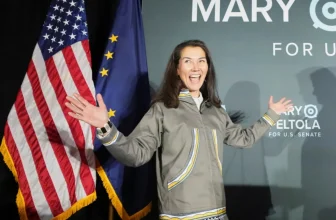
I wrote for The Poll Bludger on Saturday that Democrat Mary Peltola is certain to win the Alaska Senate runoff, defeating Republican incumbent Dan Sullivan. Last Thursday, AEDT, the Mississippi Senate runoff was called for Democrat Scott Colom, who defeated Republican incumbent Cindy Hyde-Smith.
Donald Trump won Mississippi by nearly 23 points in the 2024 presidential election, and the last Democrat to win the state’s Senate was in 1982, when Southern Democrats were still considered racist. Former Mississippi Democratic Senator John Stennis was a “zealous supporter of racial segregation.”
The victories give Democrats a 56-44 Senate majority over Republicans, gaining nine seats in the midterm elections. Seven of the Democrats’ gains came in states Trump won by double-digit margins.
In the House of Representatives, Democrats lead Republicans in called races 256 to 169, with ten still undecided. Democrats are expected to win by 260 to 175 votes, the largest Democratic majority since Congress from 1991 to 1993.
In the Cook Political Report’s tracker, Democrats win the national popular vote 56.2 to 42.3, a margin of 13.9 points, compared to a Republican margin of 2.6 points in 2024.
I said in the Poll Bludger article that Democrats’ expected 59.8 percent of seats in the House is an underperformance relative to their popular vote margin in first-past-the-post systems. Republican gerrymanders likely avoided more losses, although North Carolina’s Republican gerrymander backfired spectacularly.
Redbridge Victorian Survey
A Victorian Redbridge and Accent Research poll for The Financial Review, conducted November 3-10 on a sample of 1,008 people, gave the Coalition 31% of the primary vote (up one since the Redbridge poll in early October), Labor 23% (down one), One Nation 22% (down two), the Greens 15% (down one) and everyone else 9% (up three).
The Coalition was at its highest level since December 2025, while Labor and One Nation were at their lowest level since August. The Greens were one point away from their October high.
According to respondents’ preferences, the Coalition led Labor by 57 to 43, a one point gain for the Coalition. Labor led One Nation by 55-45.
Labor Prime Minister Ben Carroll’s net favorability fell ten points to -28 (47% unfavorable, 19% favorable). That of Liberal leader Jess Wilson loses ten points to +7 (35% favorable, 28% unfavorable). That of One Nation leader Warren Pickering was down three points at -8 (25% unfavorable, 17% favorable). That of the leader of the Greens, Ellen Sandell, is down one point to -3 (13% unfavorable, 10% favorable).
In a three-way preferred first question, Wilson had 29% (up one), Carroll 18% (down one) and Pickering 11% (up three).
As for whether the Coalition had done enough to deserve to win the next election, respondents gave a net agreement score of -4, up four points since October and 15 points since June 2025. But as for whether Labor had done enough, they gave a net agreement score of -43, down eight points since October. In the poll preceding Jacinta Allan’s replacement as Prime Minister at the end of July by Ben Carroll, Labor had a net score of -50.
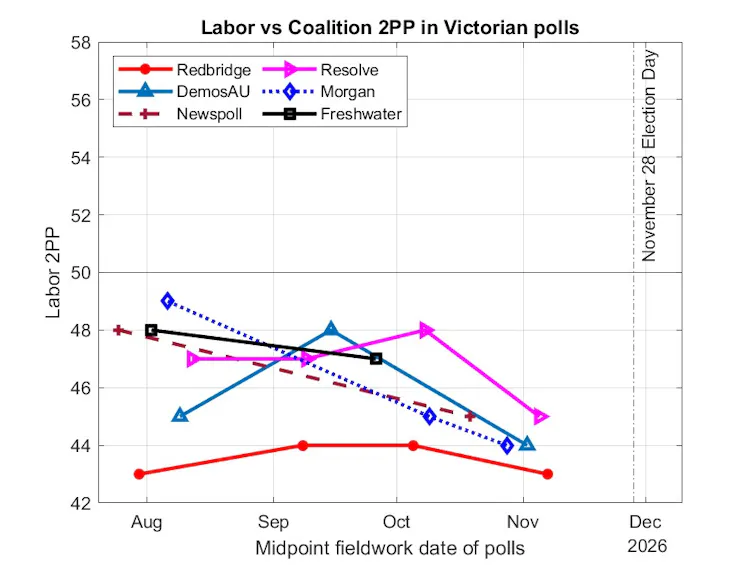
All recent polls show shifts in favor of the Coalition, and the Coalition now has a large lead over Labor, as the chart below shows.
Victorian Lighthouse Survey
The second installment of the Victorian Lighthouse poll for The Herald Sun gave the Coalition 32% of the primary vote (up one since the Lighthouse poll released on November 6), One Nation 23% (steady), Labor 21% (down one), the Greens 14% (steady) and everyone else 10% (steady).
Carroll’s net favorability increased two points to -19, while Wilson’s jumped eight points to +17.
This poll is conducted internally by News Corp. No fieldwork dates were provided, but the sample size was 1,351. There will be weekly updates to this poll until the election.
Upper house question from previous DemosAU poll
The 40 members of Victoria’s Upper House will be elected from eight five-member regions based on preferences. The electoral quotient is one sixth of the votes, or 16.7%, half of a quotient being sufficient to give a reasonable chance of being elected.
I have previously written about the DemosAU poll which gave Labor just 18% of the primary vote in the lower house. In the upper house, voting intentions were 28% for the Coalition, 20% for One Nation, 17% for Labor, 15% for the Greens, 4% for animal justice, 4% for families first and 4% for the legalization of cannabis.
NSW Resolve poll
The New South Wales election will be held in March 2027. A Resolve poll for the Sydney Morning Herald, taken with the October and November federal Resolve polls on a sample of 1,100, gave Labor 30% of the primary vote (up one since the September poll), One Nation 26% (up one), the Coalition 23% (down one), the Greens 13%. (up by two), to independents 5% (stable) and to others 3% (down by two).
This is a record high in the Resolve NSW polls for One Nation and the highest Greens vote since July 2025, while the Coalition is at an equal record high (tied with July).
No bipartisan estimate was provided, but analyst Kevin Bonham estimated that Labor led the coalition by more than 57 votes to 43, with Labor against One Nation “probably slightly closer”. NSW’s optional preferential voting helps Labor with vote allocation between a nation and a coalition.
In a three-way preferred question, incumbent Labor leader Chris Minns had 30% (up three), Liberal leader Kellie Sloane 12% (down three) and One Nation state leader Mike Newman 11% (up three).