
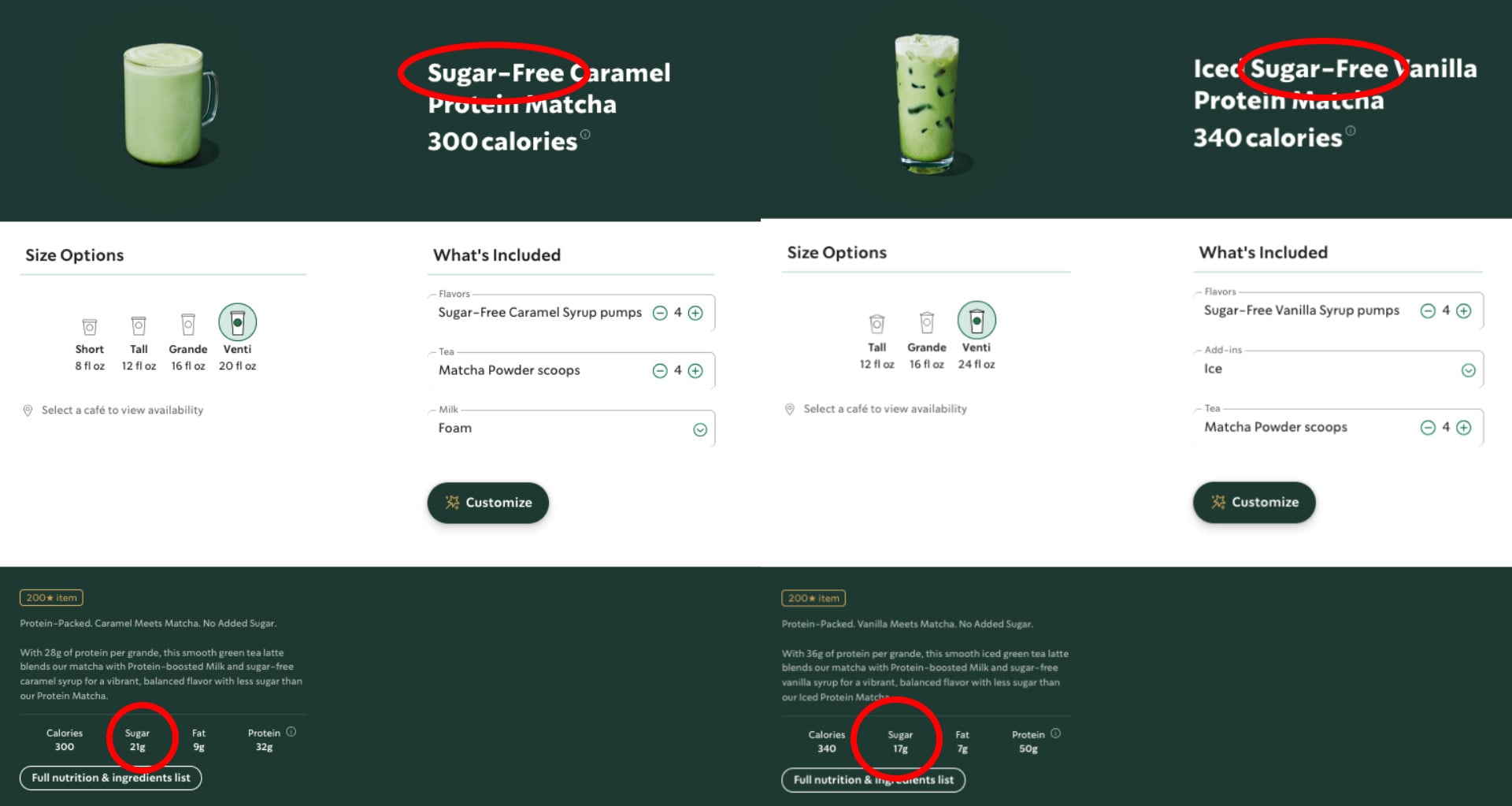
A federal lawsuit filed Friday alleges that Starbucks misleads consumers with a line of “sugar-free” drinks that actually contain a significant amount of sugar. The company denies these claims, but a quick visit to Starbucks’ website reveals that some drinks labeled as sugar-free also carry nutrition labels explaining that the drinks contain up to 21 grams of sugar.
The lawsuit was filed by the Hagens Berman law firm on behalf of plaintiffs in California, Washington and New York, according to the Associated Press. In a statement to the newswire, a co-founder of the law firm explained that it’s not just the average person trying to avoid sugar. This can have harmful consequences on the health of diabetics, for example.
“Consumers avoid sugar for a variety of reasons, whether it’s general health, diabetes, blood sugar or other factors, and for many, mislabeling like this is significant,” Steve Berman told the AP.
A search of the Starbucks website reveals drinks listed with names like “sugar-free caramel protein matcha” and “sugar-free iced vanilla protein matcha.” The 20-ounce versions of the former contain 21 grams of sugar, while the 24-ounce versions of the latter contain 17 grams of sugar, according to the site.
Reached for comment by email, a Starbucks spokesperson told Gizmodo that the company denies allegations that it misleads customers.
“We believe these claims to be unfounded,” the spokesperson said. “Starbucks has consistently and clearly provided information about its protein drinks, sugar-free options, customization choices and nutritional content in product ads, menus, marketing materials, on Starbucks.com and the Starbucks app, and we intend to vigorously defend ourselves in this matter.” »
When Gizmodo asked how these products could be listed as “sugar-free” while still containing sugar, a Starbucks spokesperson told us by phone that the sugar listed on the website “comes from milk protein intake. We don’t add sugar to drinks and we use sugar-free flavors.” When we asked for more details, since it didn’t make sense to us, the spokesperson replied: “Milk is part of the protein shake.”
At the end of our call, Gizmodo asked to verify the name of the spokesperson we were speaking with and they retroactively insisted that our conversation had been “in the background,” rather than recorded, conditions that Gizmodo did not agree to. The spokesperson said he would email more information to help clear up our confusion. They sent a link to a product announcement from September 2025, but it’s still very confusing.
“With no added sugar or compromise on flavor, Starbucks Protein-Enriched Milk will be made daily by Starbucks baristas, blending creamy 2% milk with unflavored protein powder,” the product’s old announcement reads.
Presumably, the company appears to be trying to distinguish between “added sugar” and the sugar naturally found in milk. But if that’s their argument, they should probably say so explicitly. The Starbucks spokesperson didn’t and we’re just doing our best to understand what he might mean.
Typically, when consumers see the words “sugar-free” on a label, they expect the nutritional information to also reflect zero grams of sugar. Many juices will add “no added sugar” even when they contain a considerable amount of natural sugar.
For example, Ocean Spray Zero Sugar Cranberry Juice has a nutrition label that clearly states no added sugar, but also clearly states no sugar at all. Regular Ocean Spray Cranberry Juice says there is “no added sugar” but also lists 29 grams of sugar on the nutrition label.
Gn bussni