
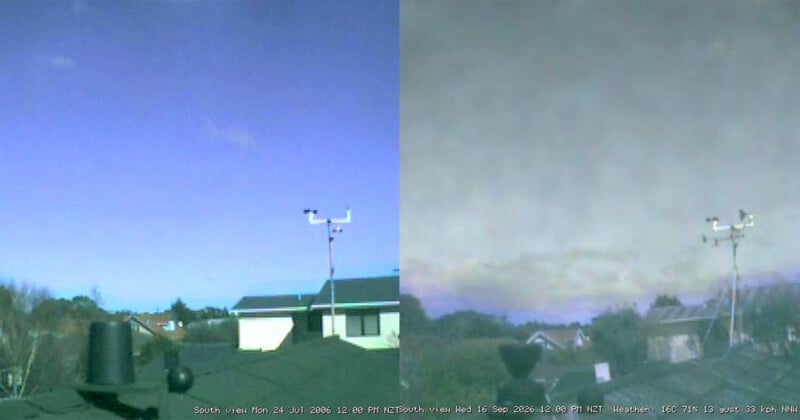
A New Zealand weather camera has captured a remarkable 20-year time-lapse showing two decades of changing skies over Lower Hutt, a town near the capital Wellington.
Trevor McGavin’s south-facing Lower Hutt weather camera has been recording 640 x 480 pixel images since June 24, 2000.
The timelapse, published by Peter McGavin, is composed of a low-resolution photograph taken each day at midday, played back at 25 frames per second; each second represents 25 days.
The camera was originally installed in the late 1990s to display local weather conditions on McGavin’s website. However, he explains on YouTube that he was unable to recover any footage recorded before 2006, meaning the timelapse covers around 20 years rather than the entire lifespan of the camera.
Images were captured using a 1990s-era StarDot Technologies WinCam Live camera, which records images at 640 x 480 pixels via an RS232 serial interface. Although it has been exposed to the elements for decades, the camera is still functioning in 2026.
McGavin says the images have been processed to reduce flicker and restore more natural colors. However, the processing also contributed to an apparent lack of sunlight in the video, with some viewers wondering why the sky appears constantly cloudy.
He explains that several factors create this impression. The flicker removal process mixes cloudy and sunny images, while extremely fast playback makes it difficult to distinguish individual weather changes. The camera’s aging CCD sensor also gradually lost its sensitivity to blue light, turning clear skies gray. Dirt accumulated inside the lens further contributed to the foggy appearance.
These effects become more pronounced towards the end of the video. McGavin points out that Lower Hutt enjoys on average more than 2,000 hours of sunshine per year, adding that the sharp shadows visible throughout the images are evidence of sunny conditions.
Timelapse also offers insight into seasonal changes in the Southern Hemisphere, where seasons occur at opposite times of year to those in the Northern Hemisphere.
Other details are less immediately obvious. The black cylinders visible on the roof are rain gauges, while the trees in the background include native New Zealand species such as totara and pohutukawa, which retain their leaves throughout the year.
Snow is particularly rare in Lower Hutt. McGavin says the only snow to fall on the ground during that 20-year period fell on the afternoon of Aug. 15, 2011, and was gone by the next morning.
Gn Health

