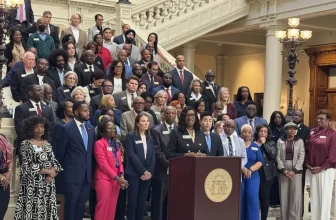
When Donald Trump was first elected to the White House in 2016, Republicans held every lever of statewide power in Arizona, from the governor’s office to seats in the U.S. Senate to a majority in the Legislature. Over the next decade, as Trump tightened his grip on the party, Democrats began to chip away at that dominance, gradually turning the Republican Party’s longtime stronghold into a political battleground.
Then came the November midterm elections. Democrats won every statewide office on the ballot — from governor to the obscure post of mining inspector — and secured a legislative trifecta not seen since 1966.
The results leave Republicans firmly locked out of power at the state level — a remarkable reversal of fortune for the long-dominant party that once housed the ragged conservatism of Barry Goldwater and the maverick streak of John McCain.
“I could see this coming,” said Gina Swoboda, former chairwoman of the Arizona Republican Party. “We weren’t talking to people, we weren’t listening to people.”
Swoboda tried. This year, she ran for secretary of state and state elections director. She lost the Republican primary to Alexander Kolodin, a Trump acolyte who was heavily involved in efforts to overturn the state’s 2020 election results. Last Tuesday, Kolodin was defeated by Democratic incumbent Adrian Fontes.
In several closely watched races, Trump’s allies fell. Rep. Andy Biggs, a longtime supporter of the Make America Great Again (Maga) presidential movement, lost by more than 10 percentage points to Katie Hobbs, the Democratic president once seen as vulnerable.
Progress has been so seismic that a 19-year-old sophomore at Arizona State University beat a Republican incumbent to become Maricopa County’s top clerk — in charge of court records, marriage licenses, child support and other records for America’s fourth-largest county.
The Republican collapse in Arizona was part of a blue tidal wave that swept Republican leaders from power in even redder states, like South Carolina and Texas. But in Arizona, a state reshaped by decades of demographic change, a population boom in suburban Phoenix and a rejection of Trumpism by wealthy Republican and independent voters, the Republican Party now faces a reckoning that many believe might have come someday but now cannot be delayed.
“The world has changed, so if there is no change from the party, we will face minority status for a long time,” said Kirk Adams, former speaker of the Arizona House of Representatives and chief of staff to the last Republican governor. “Political parties tend to react to near-extinction events like this. »
One of the most pressing issues facing Republicans in the Grand Canyon State involves rebuilding.
Republicans hold a nearly 300,000 voter advantage over Democrats in the state, but independent voters make up the largest share of the electorate and often decide elections. This year, they fought violently against the Republicans.
“Were we too Maga or not Maga enough? Adams asked about the movement that propelled Trump twice to the White House and which many now attribute to Republican losses in the state — and nationally.
For Democrats, their midterm success was the culmination of a hard-fought political transformation from the so-called “pizza caucus” — so few in the state legislature, the joke went, that they could share a single pizza — to a majority party.
“Now Arizona will have a Democratic trio for the first time in 60 years,” Hobbs wrote on X. “We’re going to need a lot more pizza.”
Among Republicans, there is no agreement on how to chart a path forward.
Some criticize their party leadership for ceding control to outside operations, like Turning Point Action, the youth group founded by Charlie Kirk and headquartered in Phoenix, and the far-right Freedom Caucus of Arizona.
Some Republicans argue that the midterm wipeout is an anomaly that won’t happen again in 2028, a presidential election year, and believe Arizona voters, still conservative at heart, will rebel again after two years of total Democratic control.
Yet others point the finger at far-right Republicans who survived the blue tsunami and say their strategy is the way to rebuild the party.
“For the record, in many places, more ‘moderate’ Republican candidates lost more ground than conservatives,” Tyler Bowyer, Turning Point’s director of operations, said in a social media post. “Many examples of this in red states and swing states.”
Bowyer also laid out a tentative game plan for 2028, calling for early agreement on a candidate to challenge incumbent Democratic U.S. Sen. Mark Kelly, securing early funding commitments from groups such as the Club for Growth and reaching out to voters who don’t vote regularly, noting that the party may need more than Republican votes to win.
Swoboda said there is clear evidence that the Republican slate is out of touch with Arizona voters. She blamed tone-deaf messaging that didn’t focus on voters’ concerns about issues like higher prices and unwanted war.
She says Republicans have lost control of the political battlefield by allowing Turning Point Action to play the role of kingmaker. The party had little money compared to Turning Point, which invested millions in the Republican campaigns of the party’s gubernatorial and congressional candidates. Their support backfired: all of their statewide candidates lost.
“We are in the desert,” Swoboda said. “Who is going to give money to a party run by Turning Point Action? »
The organization did not return a request for comment.
Adams said the party needed to be accountable for its leadership. But the midterm wipeout will make rapid rebuilding more difficult, he added.
“Usually you have a governor or a senator who has a political apparatus in place,” he said. “We don’t have that now.”
One of the state’s first Republican casualties was U.S. Sen. Jeff Flake, a classic conservative who announced in 2017 that he would not run again after realizing he could not survive a nail-biting primary election against a Trump disciple. The following year, McCain, one of Trump’s most vocal critics, died.
Their vacant seats were ultimately filled by Democrats. In 2020, Trump became only the second Republican presidential candidate in 50 years to lose Arizona. Yet the president’s loyalists in Arizona have redoubled their efforts, elevating his allies and purging the party of its critics.
In 2022, Kari Lake, a former news anchor, ran a scorched-earth campaign for governor of Arizona, declaring that her success “drove an issue to the heart of the McCain machine.” Although she triumphed in the Republican Party primaries, she lost to Hobbs, who ran as a moderate and worked to win over independents and anti-Trump Republicans. (This cycle, Hobbs even chose one to be his running mate, former Republican-turned-Independent Mesa Mayor John Giles.)
Kurt Davis, the party’s former executive director and now a registered independent, said Arizona Republicans need to return to the party’s core mission: registering, talking to voters and recruiting candidates.
Davis led the party in the mid-1980s, when Republican Gov. Evan Mecham’s racist comments, the cancellation of a Martin Luther King Jr. holiday and flawed appointments fractured the Arizona GOP. Unlike today, this divide did not bring the party to its knees: their candidate prevailed in the elections that took place following Mecham’s dismissal.
Republicans now have an opportunity to rebuild, Davis said, but they must act quickly.
“There’s a two-year timeline,” Davis said, referring to the 2028 election.
Republican strategist Nathan Sproul sees the next presidential cycle as ripe for the party’s resurrection. He thinks legislative Democrats will go too far in the next two years and that Republican voters who helped elect them — or who didn’t stay — will return to the Republican Party.
But first, Republicans must end their internal war and make room for dissent.
He cited Ronald Reagan’s comment that “the person who agrees with you 80 percent of the time is a friend and ally — not a traitor 20 percent of the time.” »
Robert Graham, who was party president a decade ago, agrees. Turning Point was “really effective at beating people,” he said, but those tactics didn’t work outside of divisive primaries.
Republicans need to talk about policies that lead to jobs, opportunity, security and prosperity, Graham said — themes that have been emphasized under his leadership.
“You have to get back to retail politics,” Graham said. To win again, the party must listen and speak to the people’s concerns, and avoid being distracted by debates about renaming the Gulf of Mexico or by smears, he added.
The Arizona Republican Party did not respond to a request for comment. But in a post-election social media post, Republican Party Chairman Sergio Arellano pledged to “take a hard look at what worked, what didn’t work, and what we need to do better.”
As national Republicans survey the rubble of their defeat and chart a post-Trump future, Swoboda urges the Arizona Republican Party not to accept the status quo.
“Where the party goes depends on what the state committee wants,” she said. “I thought the committee liked to win.”
Gn usa