Lewis Hamilton told team radio after qualifying as he returned to the pits that his first pole position for Ferrari had been “so long coming”.
But after a year in which Ferrari had too often failed to turn a promising pace into a difficult result on Saturday, the reason behind him and Ferrari ultimately performing was interesting.
The key to this breakthrough was not a major aerodynamic update, nor a track layout that gave Ferrari more advantages than at other circuits.
Instead, the answer depended on what was done before the final qualifying rounds even began.
As Ferrari found time and time again, it was difficult to get the car’s tires into the correct operating window for qualifying.
The SF-26 is known for being gentle on its rubber, which pays off in racing when you want to keep the tires cool. But this can make it more difficult in qualifying when you want to get the tires up quickly.
The challenge in qualifying is also making sure the temperatures are well balanced on both axles – so as not to be so aggressive that the fronts are sorted but the rears are too hot.
“More often than not, you’re like, ‘The front tire isn’t ready for turn 1, but the rear tires are,'” Hamilton said.
“Then the fronts start to come in and the rears start to pull away. It’s this constant seesaw you feel. Sometimes the rears aren’t ready when you come out of the last corner to start the lap, but by the end they’re better. Sometimes they’re too ready.”
“So trying to find that balance, I tell you, it’s like finding a needle in a haystack. And honestly, it’s been very, very, very difficult to find.”
In Mexico, however, finding that needle made the difference between him and his teammate Charles Leclerc – as it was a matter of getting the tires working sufficiently for the start of the lap, without the rubber then overheating too much for the critical final sector.
Hamilton’s approach to the lap was very methodical. Given a countdown from his engineer as he slowly exited the pits before accelerating, slowing and then accelerating again, Hamilton weaved aggressively down the straights at the start of the warm-up lap – but tiptoed through the corners.
His first flying lap wasn’t ideal, as his tires didn’t seem to be in the perfect window from the first sequence. He started losing time from Turn 2, then fell back further through Turns 4 to 6, and then into Turn 11.
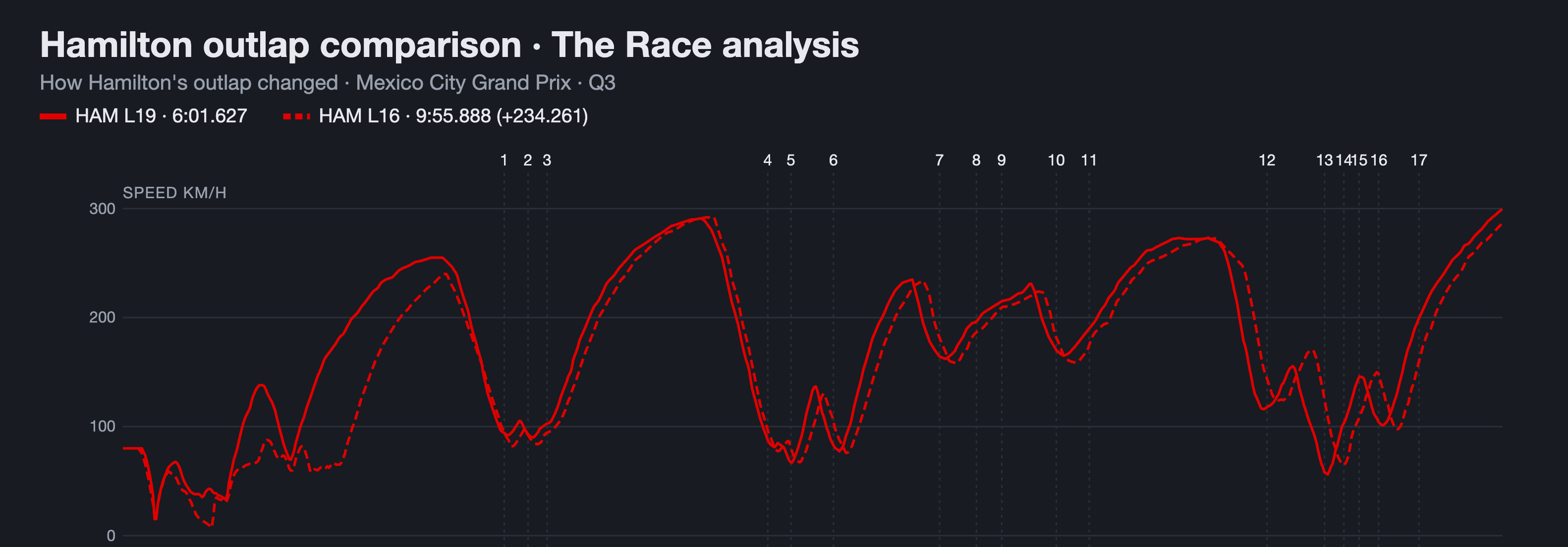
For his second lap, Hamilton was much more aggressive coming out of the pits and used a lot more throttle on each of the straights. He was also a little more careful in the stadium section before starting the lap.
The end result appears to have been a slightly different tire balance, which wasn’t as good in the early corners – as he was around 0.150 seconds behind his previous efforts coming out of Turn 3.
But after that, better acceleration on the descent to Turn 4 put him on par and the tires were in their perfect window as he finished the lap with enough to take pole.
Without giving specific details on what he did to make the difference, Hamilton said he had to draw on all his experience.
“I think I was able to use a few more tools that I hadn’t used in about 13 years,” he said.
“I just put the tires in the perfect window on that exit lap. Once I got through Turns 1, 2 and 3, everything went pretty well from there, and I just don’t think I lost any time anywhere, to be honest.”
Leclerc angry with himself
The perfect lap was something his teammate Charles Leclerc failed to achieve, as he remained clearly annoyed afterwards at having wasted a good opportunity as he finished third on the grid.
His first run in Q3, which gave him provisional first place, came after he expressed some annoyance that Hamilton in front of him had come out of the pits so slowly before accelerating.
“What is he doing?” » asked Leclerc on the team radio who had to brake on the straight at one point.
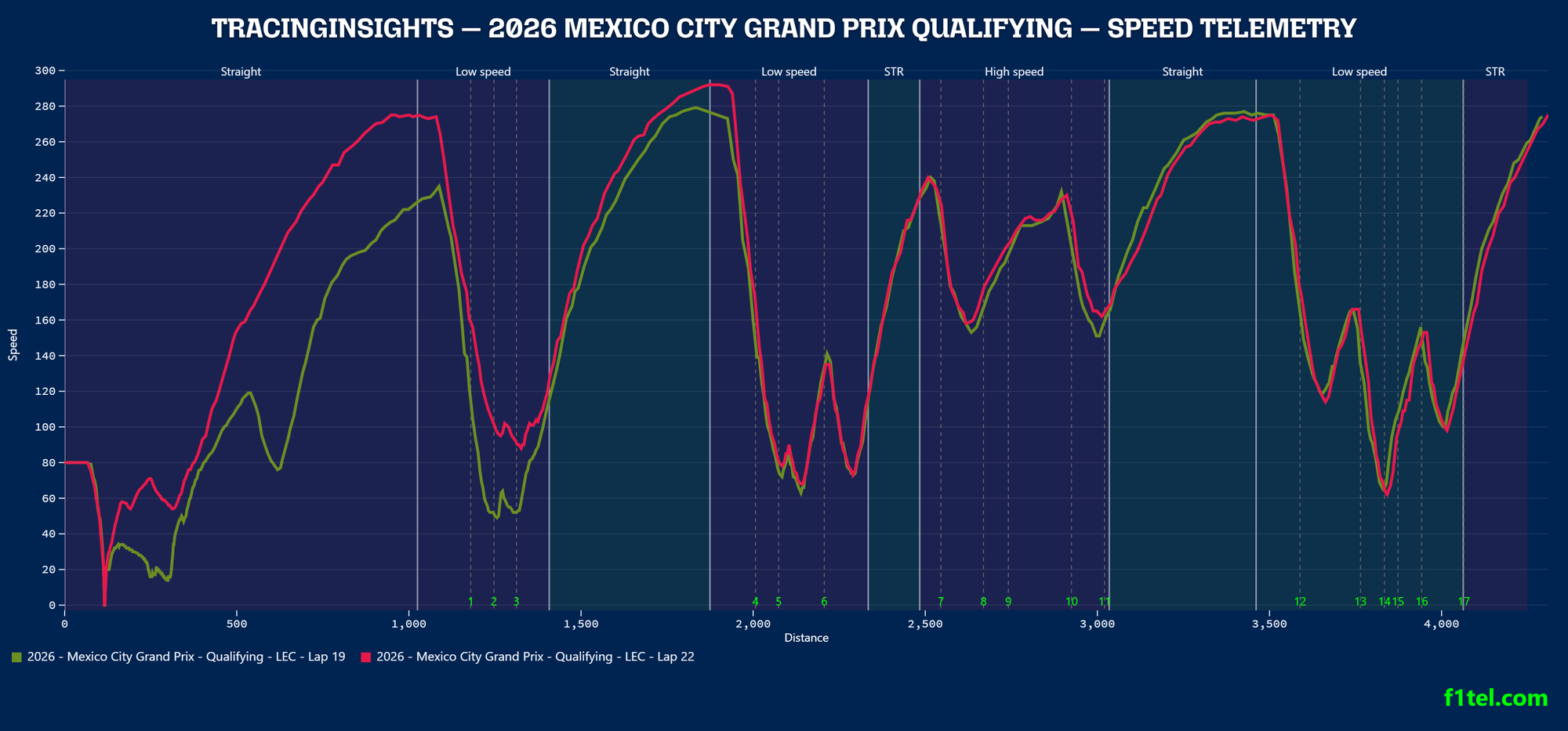
For the second run, Leclerc gave himself a little distance from his teammate so as not to be surprised by a slow descent to turn 1 to raise the tires.
His second warm-up lap was much more aggressive – he approached Turn 1 at over 270 km/h compared to around 230 km/h behind Hamilton. He was just as fast through the first sequence of corners and through turn 4.
The preparation was clean and he seemed to have warmed up the tires well for the start of the lap. He was 0.150 seconds ahead through the first sequence of corners and a tenth ahead exiting turn 6.
But the lap then went downhill as he lost a lot of time between turns 6 and 7, suggesting the rears were getting hot and losing traction.
He regained some aggression during the turn 9/10/11 sequence, which triggered a slide, but this seemed to overheat his rubber even more, meaning all his advantage vanished out of sight.
Leclerc knew he had ruined everything by subsequently lambasting the “very shitty lap” on the team radio, as well as the impact of a car that was “quite different from a normal lap”.
He also hinted that he was “really upset” by the way things had been handled.
Speaking at the post-qualifying press conference, Leclerc made no further reference to what was bothering him – but instead made it clear that he was more angry with himself.
“I just didn’t do a good enough job,” he said. “Yes, tire preparation is essential. I struggled to have the same conditions for my exit lap throughout qualifying.
“But in the end, when I had a clean lap in Q3, in the second race, I didn’t do the job. So I can only be angry with myself.”
Russell lacks answers for pace
There is perhaps no better example of the gains that come from good preparation and perfect execution than George Russell, who left himself baffled with a lap 0.009 seconds from pole position to take second place on the grid.
Russell didn’t feel comfortable with the improved Mercedes all weekend, and things hadn’t gone well throughout early qualifying as his team opted for a double-lap approach to preparation.
When that didn’t work, Russell opted to change tactics and go straight on the attack for his final run – and it sparked a rhythm that even he was unable to explain.
“That’s kind of the story of my season,” he said. “I think I feel like I’ve never had an average lap. It’s either a terrible lap or a really good lap, and it’s quite frustrating.
“I don’t think there was a single lap all weekend before Q3 that I looked in the mix to fight for the top three, let alone pole position. But that last lap went really well. I’d love to know exactly why, but I don’t have those answers.”
It also left Russell regretting the smallest details. After refueling during a double warm-up lap, the Mercedes was carrying more load than necessary – and that extra weight would likely have cost more than the 0.009 deficit with which it ended up losing pole.
“You always think in retrospect, if only we had had a lap of fuel rather than the extra lap of fuel that we had, we could have been on pole,” he said.
As Hamilton showed by taking pole, such small details can be critical – even before the qualifying round begins.
Gn sports