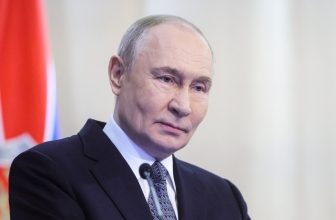
In 2018, Russian President Vladimir Putin touted six “superweapons” as he brandished his country’s nuclear capabilities, but the weapons he boasted about eight years ago have had a checkered history as the Kremlin reiterates its atomic threats.
Dmitry Medvedev, vice president of the Russian Security Council, said this week that Ukraine and NATO have already crossed thresholds that could push Moscow to consider using nuclear weapons. Medvedev has regularly made threats against the West and his latest comes as German intelligence reports that Russia could deploy a nuclear weapon in space within two months, a claim denied by the Kremlin.
Since Russia invaded Ukraine on February 24, 2022, discourse about these weapons has ranged from propagandists warning of strikes on Western capitals to the Kremlin downplaying such threats.
Learn more on World
Adding to the ambiguity are reports that some of the six nuclear weapons unveiled by Putin in 2018 were plagued by technical problems and delays.
News week contacted the Kremlin for comment.

What was MedvedevIt is Nuclear Threat?
Medvedev made the comments in an article published in the Moscow International Law Journal published Monday. He said Ukraine and its Western allies had already created circumstances in which Russia could consider a nuclear strike.
Russia did not use atomic weapons during the war with Ukraine because they were not considered necessary, although that calculation could change, he said.
Analysts have repeatedly said that using nuclear weapons on the battlefield would not provide Russia with a military advantage.
“kyiv and its allies must remember that the Russian Federation has not only the right, but also the obligation in various situations to use nuclear weapons,” Medvedev wrote in an article cited by Russian state agencies.
“The massive use of non-nuclear means that cause catastrophes makes a preemptive nuclear attack on the Russian Federation possible,” Medvedev added, although Putin “will carefully weigh the consequences” before any decision.
When did Putin reveal Russian superweapons and what are they?
Medvedev’s article recalls remarks Putin made in March 2018 during his state of the nation address after beginning a new presidential term.
The Russian leader boasted about how Russia could call upon six nuclear and nuclear-capable weapons that could thwart the world’s highest defenses. He insisted that these weapons would give Moscow a strategic capability impossible for the United States to intercept, thereby restoring Russia’s nuclear deterrent capability after the United States withdrew from the Anti-Ballistic Missile Treaty.
Meanwhile, this week, an analysis by the International Institute for Strategic Studies (IISS) revealed that one of them, Russia’s much-anticipated Satan II nuclear missile, could finally enter service. Two others were used in combat with conventional weapons, but others faced delays and problems.
RS-28 Sarmat
Nicknamed Satan II, Putin in 2018 described the nuclear-armed intercontinental ballistic missile (ICBM) as “invincible.”
However, satellite images showed the weapon failed four out of five missile tests, with speculation sparked after a crater appeared in the launch silo at the Plesetsk cosmodrome in northern Russia in September 2024.
In October 2025, Putin said the weapon was “not yet deployed, but will be soon.” This week, satellite images captured by Vantor and released by the IISS suggest the missile could finally enter service.
The footage appears to show activity around a missile silo in Ujour, Siberia, where the 62nd Missile Division of Russia’s Strategic Rocket Forces is based.
Avangard hypersonic glide vehicle
Putin described the Avanguard hypersonic vehicle as impossible to intercept, keeping Russia safe for decades. It is not a missile per se, but a payload carried by heavy intercontinental ballistic missiles, including the RS-28 Sarmat, according to Global Military.net.
During Putin’s speech eight years ago, a screen projected a CGI-generated simulation of the Avangard in flight and returning to Earth with nuclear warheads as it descended.
Nine months later, Putin oversaw a test of the glider vehicle in southern Russia, which was broadcast by the Russian Defense Ministry’s Zvezda television channel.
Russia claims the Avangard can travel at speeds more than 20 times the speed of sound (Mach 20), although neither this claim nor its combat readiness have been independently verified.

Kh-47M2 Kinzhal and the Zircon 3M22
Russia’s Kinzhal ballistic missile, which has a maximum speed of Mach 10, can carry conventional or nuclear warheads and has been fired during combat in Ukraine.
The Russian military claimed to have used Kinzhal missiles in the first weeks of the invasion, and these missiles have been fired repeatedly against Ukraine over the past three years.
Despite Russia’s initial claims that the missile was “impossible to intercept”, Ukraine said it had done so.
Putin boasted that the Zircon, also spelled Tsirkon, could destroy land and sea targets and reach Mach 9. The missile uses launch platforms on frigates and submarines and was first used in the war in Ukraine on February 7, 2024.
On March 25, 2024, Russia struck kyiv with two Zircon missiles following ground launches targeting Ukrainian decision-making centers.
On March 24, 2026, Ukrainian intelligence reported that a Ukrainian strike in Crimea destroyed two Zircon missiles and a Bastion missile launcher, damaged a second launcher, and killed seven Russian soldiers.
Poseidon and Burevestnik
Poseidon and Burevestnik are nuclear-powered and, although not intended for use on the battlefield, they are touted as having unlimited range and the ability to evade Western missile defenses.
On November 4, 2025, Putin rewarded the scientists behind both projects and announced that the weapons were ready for deployment.
However, there is little independently verified information on the true operational status of either weapon.
The Burevestnik looks like an ordinary cruise missile, but it would be powered by a miniature nuclear reactor, allowing it to fly slowly and at low altitude for thousands of kilometers, avoiding radar and missile defense systems.
The Burevestnik testing program, which has spanned more than a decade, has suffered numerous failures with at least 13 tests, with only two partial successes, since 2016, according to the Nuclear Threat Initiative.
In 2019, an explosion during a test of the weapon in Nyonoksa, in the Arkhangelsk region, killed five people.
But on October 21, 2025, a successful test flight of the Burevestnik appeared to be the missile’s first successful long-endurance test, according to the International Institute for Strategic Studies (IISS).
Meanwhile, the Poseidon is a nuclear-powered intercontinental torpedo that was tested on October 29, 2025 in the Kara Sea, off the eastern coast of the northern Novaya Zemlya peninsula.
Contact Newsweek editors about this story: Henry Holloway And Dave Siminoff.
Gn world