
Thank you for subscribing to my publications. If you’re not yet a paying supporter, consider becoming one. This will allow you to send me questions and comments in DM. Your contribution will help cover the cost of the data I use in my publications, which I fund out of my own pocket. Thank you very much for your support and feedback!
When I did it Paul Krugmanit’s incredible podcast To talk about oil prices in March, it was at the height of the panic in global oil markets. Brent was heading towards $110 and I spent an hour explaining why – an 80% increase since the start of the year – adequately assessed the congestion in the Strait of Hormuz. We recorded on March 19th – a Thursday – and the podcast would go live two days later, on March 21st. At the end of the call, Paul joked: “Hopefully oil prices don’t go crazy tomorrow, so this podcast is still on Saturday.” I really thought the same thing. Oil markets were very nervous – Brent had risen $15 over the previous week – and it seemed entirely possible that the next stop would be $150.
Markets are feeling just as nervous today. Brent was at $117 yesterday, a stone’s throw from this year’s all-time high, just above $118 on March 31. There is, however, a huge difference between now and then, which is that supply from the Persian Gulf has almost completely normalized, as I highlight in a recent report. job. If supply returns to normal, there are two remaining explanations for why prices are so high. One possibility is that demand is extremely strong, which seems unlikely given the country’s exploding debt. France And somewhere else. The other possibility is that markets incorporate a risk premium in anticipation of a return to “hot” war. I think that’s what’s happening and – just like earlier this year – this risk premium is starting to reach extreme and, in my opinion, excessive levels.
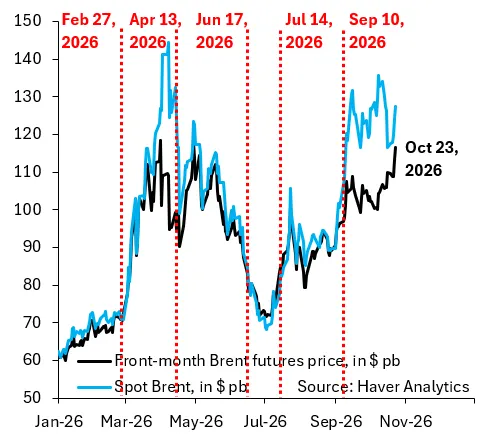
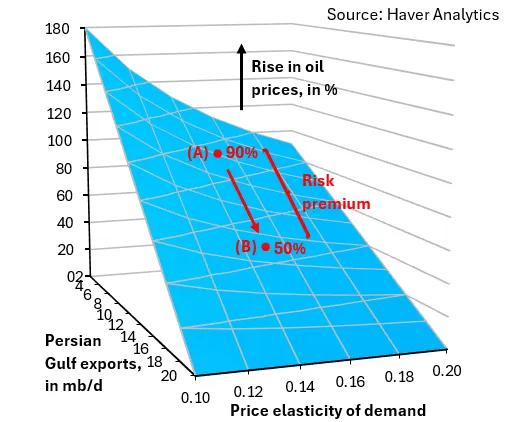
The black line in the chart above represents the front-month Brent futures price, which is now up 90% year-to-date. The blue line is the Dated Brent, i.e. the spot price, which has increased by 100 percent since the beginning of the year. Let’s go back to my 3D map of March to see what these prices imply for the supply. The horizontal axis in the chart below represents the price elasticity of oil demand, where the midpoint of academic literature estimates is 0.15, so let’s use that. On the vertical axis, a 90% rise in Brent – point (A) on the graph – supply price from the Gulf at 6 mb/d – on the axis moving away from us – while supply is actually almost back to its pre-war 20 mb/d. Now you can say that the risk of a “hot” The war after the midterm elections justifies some risk premium, but will supply from the Gulf really fall below its lowest level earlier this year, namely 8 mb/d? I think it’s extremely unlikely. Instead, I can see how we go from almost 20 mb/d to 13 mb/d – so something like point (B) in the chart – which justifies a 50% rise in Brent from early 2026 and implies a future of around $90 for the first month. All this to say that a very significant risk premium is now built into Brent, as was the case earlier this year.
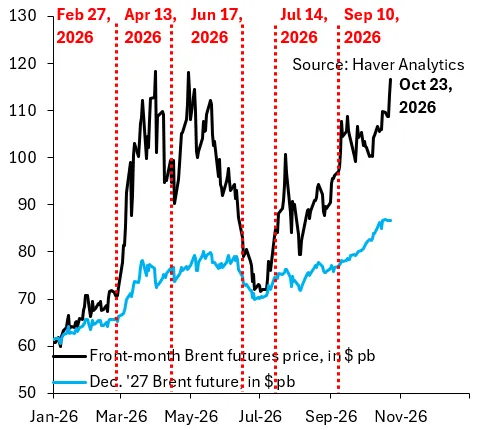
Another way to look at it is in the chart below, where the black line is the same as in the first chart, that is the front month Brent futures price. The blue line is the future of December 27. The latter has remained unchanged recently, supporting my view that the first month’s rise in Brent is entirely due to the pricing of a short-term risk premium.
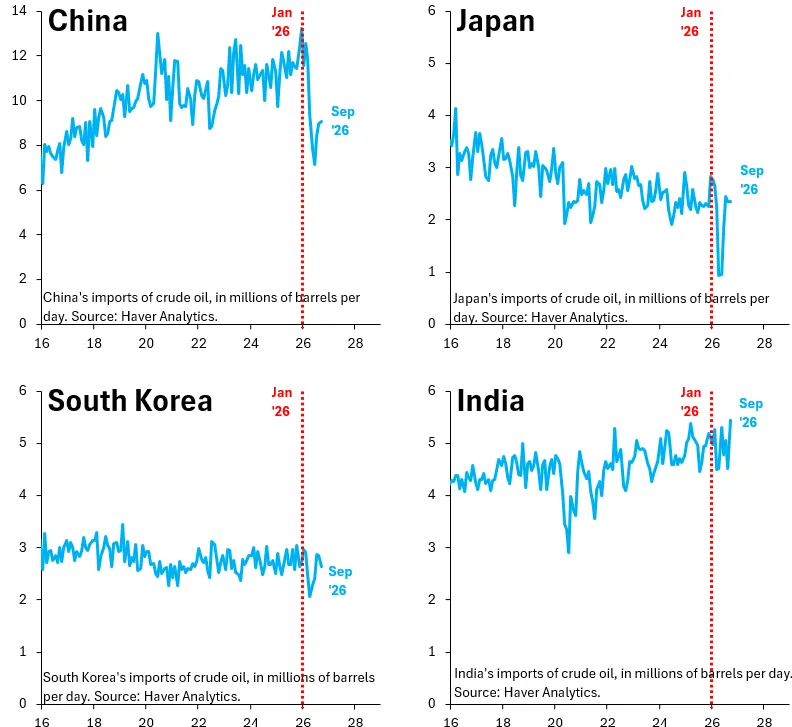
Of course, it’s also possible that high demand will drive prices up. But this argument does not fit well with the price developments we are witnessing. People may rush to buy crude ahead of what they see as a return to “hot” war. But this type of request falls under the risk premium. If I look at the actual demand, which I did yesterday job Regarding crude demand from China, Japan, South Korea and India, we only returned to pre-war levels in the latest September data, as shown in the charts below. China is about 2 mb/d below what it was before the war, which is simply the Iranian blockade. Adjust it and the level returns to pre-war levels, like everyone else.
My conclusion is that a very significant – and in my opinion excessive – risk premium is built into Brent at these levels. If we fall back into a “hot” war, I can see how the overall risk could briefly push us to $125, but that in my mind is the limit of how far we will go.
Gn bussni

