
The Trump administration’s lawsuit against Alaska, which seeks to block certification of the U.S. Senate results if the Republican nominee does not win, is the latest in a long line of actions throughout 2026 in which the administration has attempted to wrest control of federal elections from the states.
In the case of Alaska, the US Department of Justice, led by President Donald Trump, says it wants to “protect the integrity of Alaska’s 2026 Senate elections.” If incumbent Republican Sen. Dan Sullivan is not re-elected, the DOJ says, it is likely the result of voter confusion, because another candidate with a very similar name — Daniel J. Sullivan, with no party affiliation — is also on the ballot. So, in the event that Senator Sullivan fails to win re-election, the DOJ is demanding that Alaska not certify the election and instead conduct an investigation into who voters thought they were voting for.
The campaign of Democratic candidate Mary Peltola, whose potential victory in the hotly contested election could help shift the Senate to Democratic control, called the lawsuit “totally baseless” and an “unprecedented preemptive strike against democratic elections” in a court filing. Another filing says the DOJ lawsuit “asks the Court to preemptively overturn the U.S. Senate elections in Alaska and disenfranchise Alaska voters without any legal basis. It seeks to go where the law stops.”
There is plenty of other heated language in the legal documents from the case. But colorful language and legal citations are a much longer way of expressing a simple fact: The U.S. Constitution gives the president no authority over federal elections. This authority rests with the states and, to a limited extent, with Congress.
Over the past year, as the 2026 midterm elections approach, The Conversation has published a number of stories illustrating this fundamental constitutional rule. Here is a selection:
Brendan Smialowski/AFP via Getty Images
1. The Constitution prohibits presidential control
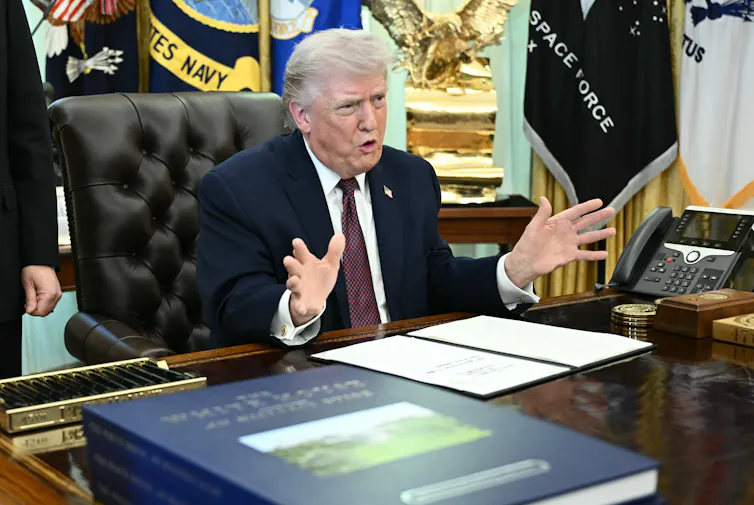
“States are empowered under Article 1, Section 4, of the Constitution to hold elections and to fix the time, place and manner of such elections,” former federal judge John E. Jones told The Conversation in an interview on April 22, 2026. Jones was discussing Trump’s March 31 executive order to take control of mail-in voting from states and turn it over to the U.S. Postal Service and the Department of Homeland Security.
Jones, who is now president of Dickinson College, explained why the framers of the Constitution established a process in which states hold elections and not the federal government:
“First of all, the federal government didn’t have the apparatus to run elections. And the states ran elections; they knew how to do it. There was a lot of confidence in the states’ ability to run elections. And there was the central debate about federalism, about what powers the states could retain, and they didn’t want to abdicate many of those powers,” Jones said.
There was also, Jones added, “a debate about the potential for fraud, that if there was a single entity controlling all elections — that is, if you centralized elections under a single politically motivated executive — that was a really difficult situation that could be abused.”
“The Constitution is clear,” Jones said. “Unless amended, Article 1, Section 4 is – to use a trite expression – what it is. The power rests with the States, absent congressional action. There is no mention of the President. None.”
Read more: Why Trump can’t just enact changes to mail-in voting – a former federal judge explains how the executive order is ‘a solution in search of a problem’
2. Limits to Congress too
The Republican-controlled House also tried this year to attack states’ constitutional power to regulate elections and determine who can vote.
In February 2026, the House, urged by Trump, passed the SAVE America Act. The law would have required those registering to vote in federal elections – in person – to “provide documentary proof of their United States citizenship.” It also required certain people voting in federal elections to provide proof of their U.S. citizenship.
John J. Martin, an election law expert at Quinnipiac University School of Law, wrote that the law “presents a constitutional dilemma. By requiring individuals to present documentary proof of their U.S. citizenship to vote, the SAVE America Act implicitly says that someone must be a U.S. citizen to vote in federal elections.”
In other words, Martin wrote: “Congress would establish voting qualification, a power that the Constitution leaves exclusively to the states. Normally, when state and federal laws come into conflict, the Constitution’s Supremacy Clause states that federal law takes precedence. Yet in this case, where Congress has no actual authority to implement voter qualifications, the SAVE America Act would appear to have no constitutional basis on which to stand.”
The Senate has been reluctant to pass the SAVE Act this year, so this particular constitutional battle has not yet made it to court.
Read more: Citizenship voting requirement in the SAVE America Act has no basis in the Constitution – and ignores precedent that only states decide who can vote
3. A ban on federal limits on mail-in voting – so far
David Ryder/Getty Images
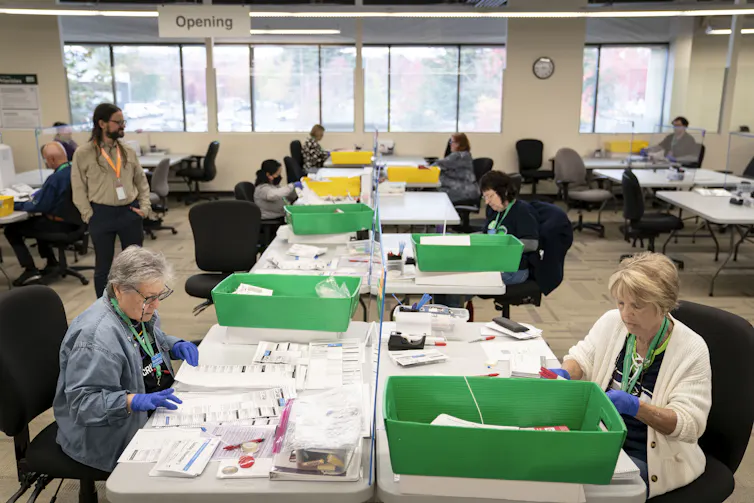
Trump frequently targets mail-in voting, saying it is riddled with fraud. The presidential decree of March 2026 aimed, he said, to guarantee “the integrity of federal elections” by imposing severe restrictions on postal voting.
Among the order’s provisions was a directive to the U.S. Postal Service to implement, elections specialist Martin wrote, “uniform ballot and envelope requirements for mail-in and mail-in ballots used in federal elections.” The order also requires states to “furnish to the Postal Service, 60 days before Election Day, lists of all voters eligible to vote by mail or absentee ballot.”
An absentee ballot that did not meet the Postal Service’s requirements, or was sent by someone not on a state-provided list, would not be delivered by the Postal Service, Martin wrote, “effectively voiding that vote.”
Lawsuits were filed by a host of state officials and voting rights groups. The lawsuits eventually reached the United States Supreme Court.
Martin summarized their arguments: “The president does not possess the unilateral power to change the methods of voting in federal elections. Rather, the Elections Clause of the Constitution provides the authority to regulate the ‘time, place, and manner’ of federal elections in the states. Congress also has the power to regulate federal elections, if it chooses to do so.”
On September 14, 2026, the Supreme Court apparently agreed, by a vote of 7 to 2, upholding a preliminary injunction blocking the new rules.
Read more: Why the Supreme Court blocked Trump and the Postal Service from restricting mail-in voting for the midterm elections
Gn usa

