
“There is no product in the world better designed to be your personal smart hub than the iPhone.”
That’s the statement that new Apple CEO John Ternus made during his keynote speech at his first iPhone event this year. So it’s no surprise that the device holding much of your data plays a vital role with a separate “smart personal hub” that stays inside your home.
This week marks the arrival of HomeView, Apple’s long-rumored smart display that was announced last month. As I explained in detail in my review, it’s basically a combination of several gadgets in one. It’s both a visual interface and a smart speaker that always listens to your Siri requests. It is a smart home hub for a range of connected devices. It’s a sous chef in the kitchen and a FaceTime station when you need to catch up with friends and family. Hell, it’s even a digital photo frame.
However, HomeView does not run applications. It performs all of these functions and more by mirroring the apps you have on your iPhone or iPad. Instead of letting you download software from the App Store, the HomeView system works like CarPlay in your car. It shows you compatible apps you already have installed on your phone or tablet, as well as Apple’s core suite, including Calendar, Messages, Reminders, and Weather.
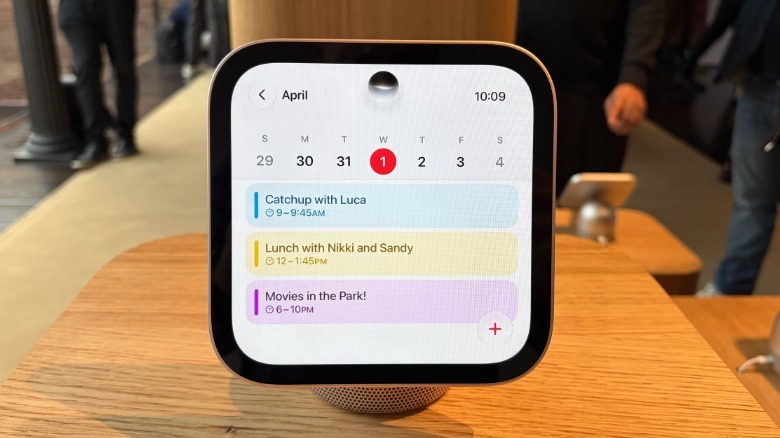 Billy Steele for Engadget
This is just one reason why an iPhone (or iPad) needs to be nearby for HomeView to work.
“When we design home products, we always keep three things in mind,” Cecilia Dantas, a member of Apple’s home products marketing team, told me. “They have to be smart, personal and private.”
Since Siri AI needs all of these apps to be able to provide the very personal context that makes its responses more intelligent and conversational, Apple needed a way to grant it this access that didn’t compromise your privacy. Having your iPhone as the sole container for this information and requiring it to be present for your data to be accessible helps protect it from prying eyes when you’re away.
As a more general home hub, HomeView should work for everyone in your household so they can turn off the lights or see who’s at the door. But don’t show them every text message you get from your parents or reveal your calendar invites and inadvertently spoil the surprises. This privacy is why, in addition to built-in facial and voice recognition, HomeView leans so heavily on an iPhone or iPad.
“Everything that feels natural on a phone is now available in a subtle, visible device that gives you what you need in the moment,” said Matthew Costello, vice president of hardware engineering. “It recognizes you and shows you your information, but when you walk away it disappears.”
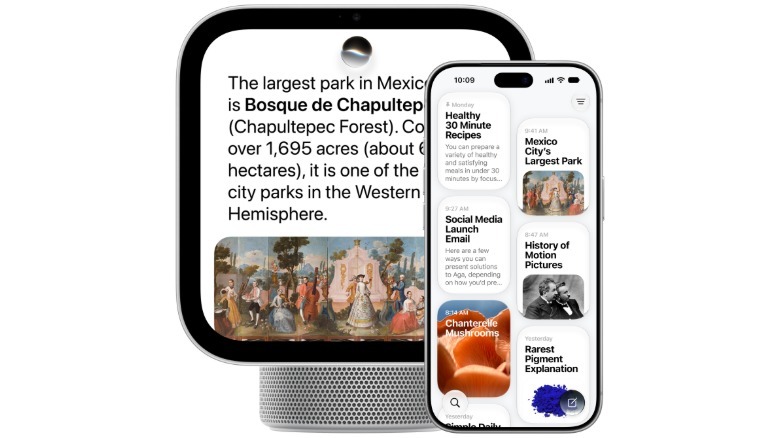
Costello further explained that HomeView offers the best combination of personal information with the convenience of a dedicated common device. Given that the iPhone is the user’s hub for their personal content – and indeed, their life – it made sense to “extend and tie that intelligence” into products like HomeView.
If HomeView does not recognize a user, it will only allow them to perform basic tasks. And even if you’re a trusted user, you’ll need to have your recently unlocked iPhone or iPad nearby for the smart display to show things like your messages or calendar.
“Personal information only appears once you have been recognized by your face and (if) your paired iPhone is present and recently unlocked,” Costello noted. “We thought that relying on contextual information and intelligence, but also relying on privacy, was extremely critical and very unique.”
By pairing what’s displayed to you on HomeView with your phone, your data is displayed as you interact with the device and disappears with you when you do. As Costello explains, it is in no way “published or hosted on the device.”
Heavy reliance on an iPhone or iPad has additional benefits. Just like you can on a HomePod, HomeView lets you stream music, FaceTime calls, and more. One of the best features of the device is the recipe integration in Safari which makes cooking easier. It’s also powered by Transfer Action, so you need that other Apple device to initiate the process. But Dantas explained that Apple doesn’t view relying on your phone or tablet as a barrier.
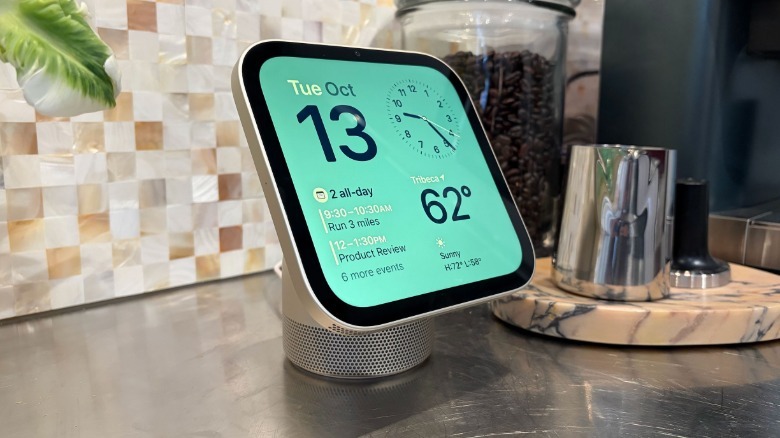 Billy Steele for Engadget
“It’s not just about addiction, it’s also part of this ecosystem,” she said. HomeView’s similarity to your phone allows for not only familiar apps, but also a familiar method of interaction.
Speaking of interaction, there’s a reason there aren’t any buttons on HomeView. Apple intentionally built it like that. I found this strange, given that the device is a bit of a hybrid of an iPad (touchscreen), an Apple Watch (square shape), and a HomePod (speaker), two of which have physical buttons. But Costello said touch input was always meant to be secondary.
“We always envisioned it as something that was voice first, touch second,” he explained. “When we (designed) the product, that’s the way we thought about it, which was to eliminate physical buttons and controls.”
For Dantas, one of the main challenges during the product development phase was rigor. The process of bringing a new product and software to life was obviously a daunting task, but the engineering team also had to determine which parts of Apple’s existing devices and services to include and which to leave out.
“We’ve been offering home products for a while and we’ve built on that,” she said. “I think it was really, really difficult to decide what we brought and what we didn’t bring (to HomeView). It was very intentional to provide this powerful, simple experience.”
Gn tech