
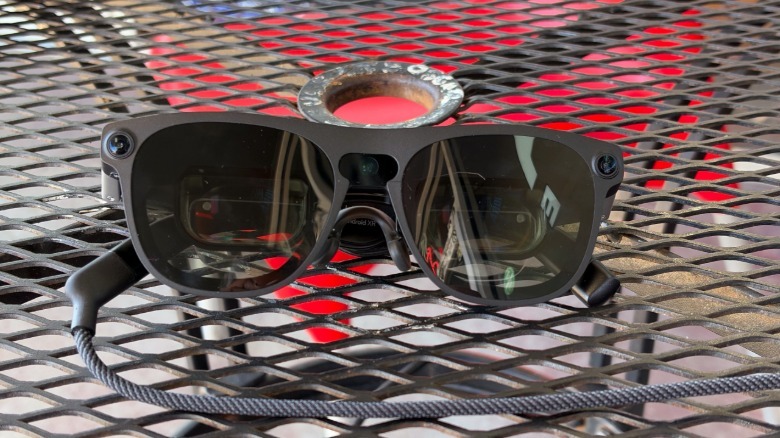
The Xreal Aura is exceptionally comfortable to wear; the frames weigh just 95 grams (0.2 pounds) alone, compared to the Vision Pro’s 1.6 pounds. The Aura is also fantastic for watching movies on a gigantic virtual screen and is incredibly useful if you need a large virtual monitor. But it’s also clear that Android XR is still in its infancy, as there aren’t many notable apps to show off the platform. Using Android (There are definitely shades of the same laziness that annoyed me with Google Books.)
It doesn’t help that apps often crash in Android XR or that its main hand recognition interface looks dull. The Xreal Aura is often slow to respond to where my finger is pointing or to recognize when I pinch my fingers to select something. It’s annoying enough when just browsing Chrome or YouTube, but it’s infuriating when trying to play an XR game like Cubismwhich relies on placing 3D blocks in very specific locations. Simply pointing to navigate in Android I quickly began to prefer navigating Android XR with the Compute Puck’s trackpad instead of pointing at everything.
 Devindra Hardawar for Engadget
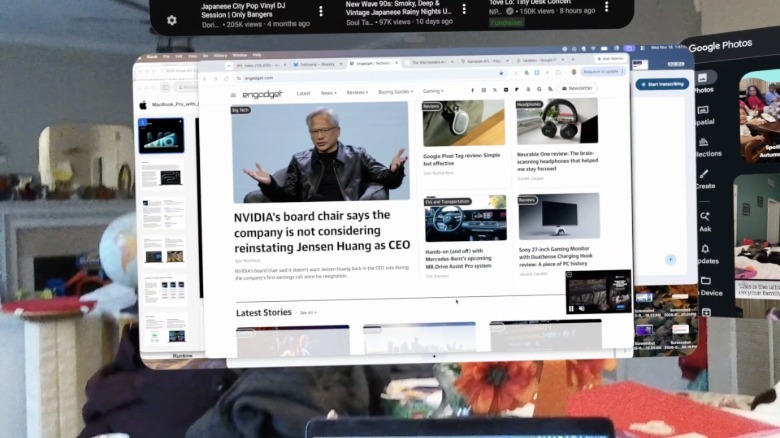
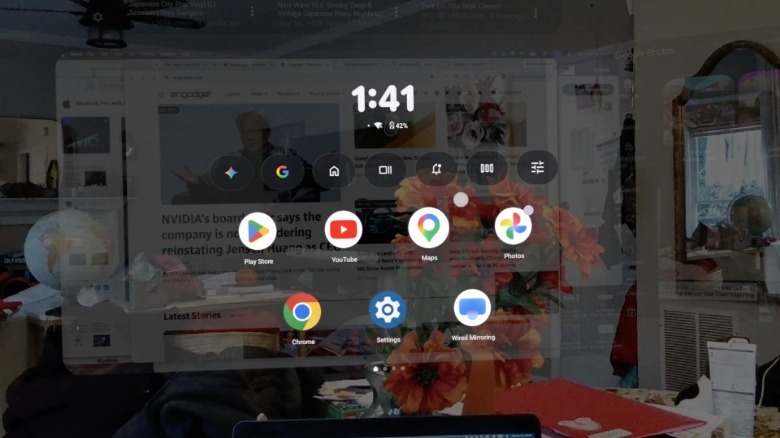
I was able to sit back and enjoy the Xreal Aura while watching the opening of Casino Royale on Prime Video, as well as a few episodes of the new Ghost in the shell series. Xreal’s micro-OLED displays deliver vibrant, colorful video, and its speakers built into the Aura’s thick bezels sound great. The Aura is also a great laptop companion: I was able to have a giant screen mirroring my MacBook Air while playing the YouTube app right next to it.
Still, I wish there was more to do in Android XR. Zooming around the world in Google Maps’ immersive view is fun, and I’ve enjoyed revisiting VR experiences like Invisible cosmos: black holes, but they are not as exciting as traditional VR headsets. Being able to easily see the outside world is both a blessing and a curse for Xreal Aura. You can also see spatial versions of images in the Google Photos app, which is cool at first, but quickly starts to look gimmicky. Likewise, I didn’t see much value in Android XR’s spatial mode, which converts everything you see to pseudo-3D. It just gave me a headache when browsing the web.
 Devindra Hardawar for Engadget
Third-party support is clearly lackluster, especially when it comes to entertainment apps. All I saw was HBO Max and Prime Video, no Disney+ or Netflix (which isn’t on visionOS, to be honest). You’ll have to watch all your other streaming services through Chrome, which isn’t exactly a premium experience. This is also a particularly bad aspect when Meta recently launched support for 3D movies (including in the Disney+ app) on the Quest 3, 3S and its upcoming VR glasses. This is something Google could eventually bring to Android XR, but who knows when that will happen.
Even the proprietary YouTube app is a disappointment. There’s a specific section for immersive videos, but it’s filled with the same blurry 360-degree content we’ve been seeing for years. There’s not a big push for higher resolution 180-degree 3D video like we’ve seen on the Vision Pro, or like Meta has advertised for its VR glasses.
Android XR is such a barren landscape that I’ve sometimes found it more useful to just connect the Xreal Aura directly to my laptop or phone. At this point it’s purely a virtual display, but I found it useful when I just wanted to stream a TV show in a crowded or tight space. The downside here is that connecting another device to the Compute Puck involves juggling a second USB-C cable, which can easily become frustrating. The Vision Pro can connect wirelessly to Macs, so it manages to avoid this problem.
 Devindra Hardawar for Engadget
Without the baggage of Android XR, the Xreal Aura was also capable of providing a brighter, sharper virtual view of my MacBook Air’s desktop. There is slight blurring on external devices when using the Compute Puck, making text difficult to read. This is not a problem when you are directly connected to the glasses. But if that’s the case, why not just grab some of Xreal’s existing display glasses? (More on this below.)
Battery life is another potentially worrying variable. The Aura’s battery drained to 40% after just 90 minutes of watching Prime Video content, browsing the web, and manipulating the immersive Google Map view. This lasted another 95 minutes before completely burning out as I caught up. Ghost in the shell.
The heat output of the Compute Puck was also very noticeable. Its small fan often felt like it was working hard to cool the device, and I was afraid to put it in my pocket like I do with the Vision Pro’s battery. Xreal recommends avoiding pockets and other enclosed spaces while the Aura is doing serious work or fast charging. That’s likely why the company bundles a lanyard and belt holster in the Aura’s box.
Since the Xreal Aura also features top-tier cameras, I was hesitant to use it in public spaces, where people might confuse it with Meta’s Ray-Ban “evil glasses.” This is a problem that the company’s cheaper display glasses avoid completely because they are camera-less (unless you add an additional accessory). I could just point out these specs and tell any concerned coffee shop neighbor that they don’t have a camera.
Gn tech