

GETTYSBURG, Pa. —
A York County mother is turning a terminal cancer diagnosis into a mission to help others.
Trisha Lane was first featured on WGAL’s “Power of One” series a year ago, when she shared her battle with stage four metastatic breast cancer. Lane, a mother of three, learned she had cancer in 2020. A week later, she was told the cancer had already spread.
Since then, Lane has continued her treatment while sharing updates on social media and advocating for more research into metastatic breast cancer.
“Even recently, you know, I shared on my online presence that I had no signs of illness,” Lane said. “And I know it was very confusing to people because many thought that I was cured, that I was no longer on treatment – you know, that I was no longer living with cancer. And that’s just not the reality of someone living with metastatic breast cancer or stage four breast cancer. We will always be on ongoing treatment. We will always be fighting this battle, and things can change very quickly.”
A changing scanner, but processing continues
Lane said earlier this year that his exams showed no signs of illness, but more recently there had been a slight progression. She said the treatment helped keep the situation under control.
“I had a little progression with the treatment, but we increased the dose, and it seems to be keeping things in place,” Lane said. “I go in every three months for a scan, and we just make sure the spots don’t get bigger. And right now, they don’t. So I’m just focusing on life between these scans and appointments.”
Lane said the illness and treatment take a constant toll, even when she appears healthy.
“It kills not only the cancer cells, but also my healthy cells,” Lane said. “For a lot of people, they think I’m really healthy because I have hair, I’m not fragile. I look for all intents and purposes like a 37-year-old. I look like I’m doing the things I love and I’m active, but it’s affecting my body in a much quieter way.”
Hope, legacy and advocacy
Lane said her legacy is her activism and her three children. She was initially told she only had one to two years to live, but she is approaching six years since her diagnosis.
“The projected prognosis is that I’m going to live a lot longer and we’re just going to take it day by day,” Lane said.
Fundraising for Breast Day this weekend
She’s also preparing for a charity event this weekend to raise money and awareness for metastatic breast cancer research.
The annual golf outing and fundraiser, called Breast Fest, is scheduled for Saturday, Oct. 10, at The Links at Gettysburg on Mason Dixon Road. The event will run from 7:30 a.m. to 7:30 p.m. and will include morning and afternoon shotgun races, coffee and donuts, lunch, silent auction, raffle baskets and an awards ceremony.
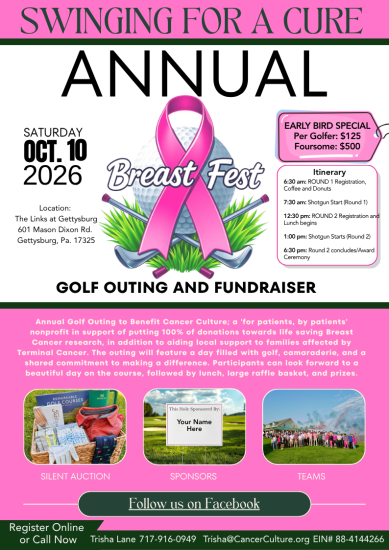
The event supports metastatic breast cancer research and families affected by terminal cancer through Cancer Culture, a nonprofit organization founded by Lane.
More than 175 golfers are registered this year.
“I think cancer is something that, even though I don’t have it personally, affects everyone,” said Carrie Mosley, an event volunteer who has known Lane since elementary school. “It’s touched my life through those close to me – obviously through friends like Trisha – and I just think it’s an important cause for people to get involved with.
Lane said she hopes people leave inspired to help.
“Every little thing helps in something like this. I hope people walk away feeling empowered to help,” she said. “I hope that the cancer community that is here feels empowered, knowing that we have volunteers and that we have loved ones that care about them and want to show up for them.”
Why metastatic breast cancer research is important
Metastatic breast cancer occurs when cancer cells break away from where they initially formed in the breast and travel through the blood or lymphatic system to another part of the body. It most often spreads to the bones, lungs, liver or brain.
Even after it has spread to another organ, it is still breast cancer. For example, breast cancer found in the lungs is treated as metastatic breast cancer, not lung cancer. Likewise, breast cancer that spreads to the bones is not bone cancer.
Although treatments can slow or stabilize metastatic breast cancer, the disease remains difficult to treat.
“Unfortunately for metastatic patients, these cancer cells remain,” Lane explained. “Once they become resistant to this drug, they will start to circulate again and spread the cancer to other areas. That’s why it’s such a devastating diagnosis, because it’s not curable. That means it’s a terminal diagnosis.”
The National Cancer Institute says metastatic breast cancer may stop responding to one drug over time, forcing the patient to switch to another treatment. Some medications may also have difficulty reaching cancer in certain parts of the body, including the brain.
The survival gap illustrates the challenges patients like Trisha face. According to the National Cancer Institute, the five-year relative survival rate is 99.3% when breast cancer is detected only in the breast. When it is diagnosed after spreading to a distant part of the body, that rate drops to 31%.
These statistics are based on large groups of patients and cannot predict the outcome of an individual person. They may also not fully reflect the impact of new treatments.
“Metastatic breast cancer is the only form of terminal breast cancer,” Lane said. “It’s the only form of breast cancer that can kill someone. That’s why it’s so important that we fund better treatments and research with a cure in mind.”
Trisha said she would consider it a victory to be able to manage metastatic breast cancer as a chronic disease.
“I think anyone would consider living with this chronic illness a victory,” she said. “Even if we don’t find a cure, just knowing that I will be there for my children, to raise them, and I don’t have to question that.”
Recent advances show why research – and funding that research – matters. The goal is not only to help people with metastatic breast cancer live longer, but also to prevent the spread of breast cancer and, ultimately, to find lasting treatments for every patient, regardless of their horizon.
Trisha said meaningful change requires an entire community.
“It’s not my power,” she said. “I’m one of many, but it takes each person coming together. So that’s their power. It’s the power of you individually and how you can provide help to your community and to the people who need it most.”
Source: National Cancer Institute. Survival rates cited are for women diagnosed from 2013 to 2019.
The power of one
You can watch Tasmin Mahfuz’s previous Emmy-nominated Power of One stories about Trisha’s journey in four parts.
Gn Health