
Over the course of human generations, the tectonic plates that form the Earth’s crust and upper mantle move incredibly slowly.
However, they are constantly moving, and over millions of years this movement causes significant changes to the landscape.
Researchers led by a team from the Chinese Academy of Sciences have discovered extensive evidence of two giant tears in a tectonic plate called the Arabian Plate, located beneath southeastern Iran.
The tears are caused by different densities of rocks. Part of the plate is what is called an oceanic slab and was once part of the ancient Neo-Tethys Ocean.
The basalt rock here is heavier and finer and is pushed under a neighboring plate (subduction process).
Meanwhile, the other part of the plate is made up of continental rock – thicker but less dense in composition, with lighter ingredients that make it granite-like.
This rock does not like to be pushed underground and forms mountains when it meets resistance. This inadequacy is at the origin of the ruptures.
In a new study published in Natural geosciencesThe researchers detailed their findings, explaining how these findings give us a new perspective on how oceans disappear and continents collide as tectonic plates shift.
Plus, there’s a good chance those tears will come together eventually.
“The coexistence of these two tearing modes provides a rare snapshot of the early, short-lived transition between oceanic subduction and continental collision,” the researchers write in their published paper.
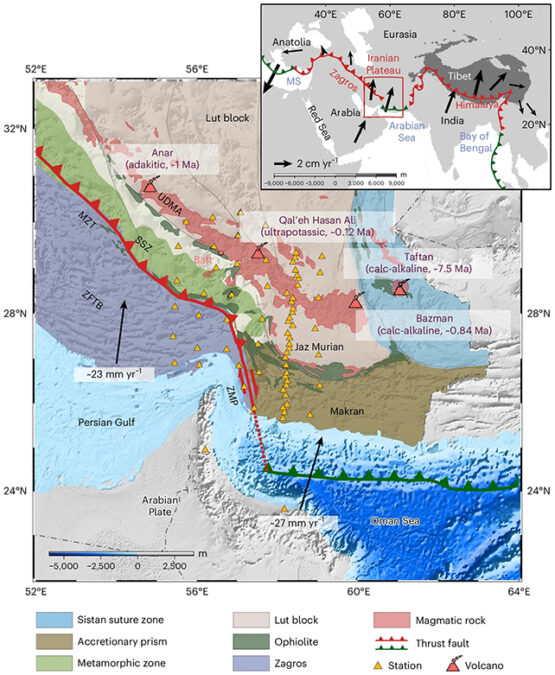
To measure geological activity at depth, the researchers used a network of 69 different seismic monitoring stations to detect vibrations from distant earthquakes.
As the speed of these vibrations changes depending on the temperature and density of the rock, a picture of tectonic plate activity can be formed.
The recordings, made between March 2017 and September 2018, revealed two tears: a horizontal one (where the Zagros collision zone meets the Makran subduction zone) and a smaller vertical, closer to the surface (at the Makran trench).
“We show that in the Makran subduction zone, oceanic lithosphere continuously subducted to depths of at least 450 km, whereas in the Zagros collision zone to the west, continental lithosphere only subducted to depths less than 300 km, leading to tearing and detachment of slabs to the east and south,” the researchers write.
“We further identify another slab tear that likely began at the junction between the Makran Trench and the Transform Boundary and propagated southward as the continental plate advances northward.”
This second tear is more due to plate movement than differences between oceanic and continental rocks, the researchers suggest – but seeing them both at the same time in the same region is very unusual for geologists.
These plate tears have been progressing for several million years, according to the models studied, and these same models indicate that it is likely that they will eventually meet.
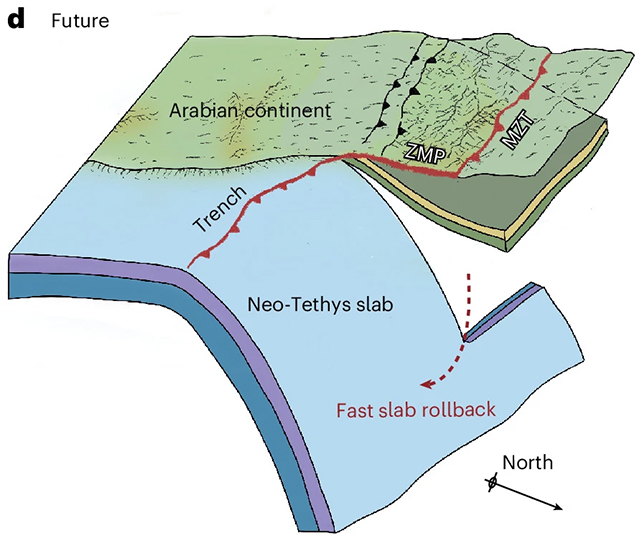
“While the two rips begin independently, the middle segment of the continental-oceanic boundary is gradually consumed as the rip advances,” the researchers write.
“This gradual bond should eventually lead to the fusion of the two tears.”
The next question is how these tears, and their eventual melting, might affect volcanic activity in the region. It appears that hot magma is already filling some of the gaps caused by the ruptures.
We may have left planet Earth by the time the tears are mixed, but for today’s geologists, it’s a rare glimpse of these forces at work, particularly the final stages of the Neo-Tethys Ocean – part of the Wilson cycle that describes how oceans form, expand, and then gradually disappear as tectonic plates shift.
“The transition from oceanic subduction to continental collision is a key stage of the Wilson cycle,” the researchers write.
“Yet the key processes governing this transition remain unclear due to the paucity of observations of deep structure.”
The research was published in Natural geosciences.
This article was fact-checked by Peter Dockrill and edited by Peter Dockrill. Although we are proud of our process, we are only human. If you spot an error, please let us know.
Gn world

