SHENZHEN, China (AP) — The Asia-Pacific region must pursue more open trade and equitable growth if it wants to remain stable and dynamic, China’s president said. Xi Jinping » declared business leaders gathered Wednesday in Shenzhen, the technological and financial center of southern China, on the sidelines of the annual congress. Asia-Pacific Economic Cooperation summit.
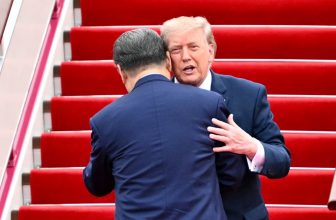
WE President Donald Trump arrived for the APEC Leaders’ Summit on Wednesday from the Philippines, where he attended the annual summit of the Association of Southeast Asian Nations.
Trump’s “America First” approach to tariff hikes and other measures runs counter to APEC’s goal of eventually forming a free trade area in the Pacific region. The United States limits China’s access to cutting-edge American technologies, as Nvidia computer chips which help power artificial intelligence, are a constant source of tension with Beijing.
Xi and other APEC leaders have called for a more open approach, without directly criticizing the U.S. desire to protect its own markets.
APEC Summit Venue Highlights China’s Central Role in Trade
The summit highlights Shenzhen, which China has transformed over the past four decades from a fishing village to a skyscraper-studded center for the export of manufacturing and technology products. the rise of China as second largest economy depended on global investment and access to global markets, with global manufacturers moving their factories overseas to access cheaper labor and faster-growing markets.
“China will not only cut tariffs and expand market access, but will also go further. We will carry out reforms in difficult areas such as rules, regulations and standards,” Xi said at the CEO summit, reiterating Beijing’s commitments to improve conditions for global investors.
“While pursuing its own development, China has shared opportunities with other countries and worked for common development,” he said. “This has gradually brought stability and predictability to global economic growth as well as international trade and economic cooperation. »
Xi’s speech underscored China’s goal of leading global industrial transformation, said George Chen, partner and chair of the digital practice at The Asia Group.
“Although he did not say it explicitly, his message was clear: China wants to be seen as a partner in global technological development, in contrast to Washington’s more restrictive approach,” Chen said, noting that Xi did not directly mention export controls, Nvidia or the United States.
Pressures lie behind the glitz and positivity of free trade
Xi faces domestic pressures from slowing growth, as retail spending and investment have slowed as China endures a prolonged property market slump. The economy continues to grow at a rate above 4%, but this is mainly due to the surge in exports which is causing a backlash among many of China’s trading partners. China’s trade surplus for this year is on track to exceed $1 trillion for the second year in a row.
Yet Trump’s emphasis on friendly relations with Xi could lead to a extension of the trade truce reached last year after a series of tariff increases.
Friction with Washington Rising U.S. tariffs and other trade barriers are leading to realignments among other trading partners. Tuesday, Canadian Prime Minister Mark Carney They met with Xi and agreed to reduce tariffs on each other’s products. Carney has cultivated closer economic ties with China and the European Union in response to tensions in Canada’s relationship with Trump.
“Canada is undergoing its own transformation. We are transforming global uncertainty into national opportunity in a more dangerous and divided world,” Carney said at the CEO summit. “Canada is choosing the path to a stronger, more prosperous and more resilient future. »
Malaysian Prime Minister Anwar Ibrahim told the heads of China’s largest companies and multinationals that the largest economies should recognize that fair and dynamic growth benefits everyone.
“Countries cannot impose their position, their own particular circumstances, on the countries that decide,” Anwar said. “They must accept that countries must emerge, focus on trade and investment, because this would ultimately benefit their populations. »
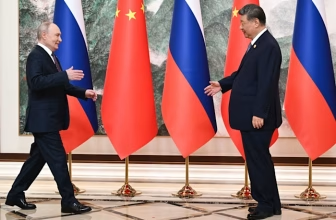
Putin targets sanctions, says Asia-Pacific is vital for Russia
Russian President Vladimir Putin attacked “instruments of economic domination”, such as sanctions imposed following the 2022 elections. invasion of Ukraine.
“Sanctions, tariffs and export restrictions” have “outlived their usefulness and have largely lost their intimidating effect,” Putin told the CEO summit in his first in-person appearance at an APEC leaders’ meeting since 2017.
He highlighted his country’s desire to cultivate closer economic ties with the Asia-Pacific region, saying the region accounts for more than half of its total trade.
Russia has submitted its candidacy to chair APEC in 2035, Putin said.
The 21 APEC economies represent 60% of global economic activity, half of global trade and 40% of humanity. Leaders will meet behind closed doors on Thursday, while holding other meetings on the sidelines of the event. This will include a “trilateral” meeting between Trump, Putin and Xi, the first such summit between these three world powers.
APEC does not make binding decisions, but for 37 years it has served as a forum for building consensus on cooperation and more open trade.
“The decisions we, and especially you, make today, individually and collectively, will determine whether the APEC region and the international community continue to be a source of dynamism, stability and opportunity in an increasingly uncertain world,” Anwar said.
___
Associated Press writer Kanis Leung in Hong Kong contributed to this report.
Gn world