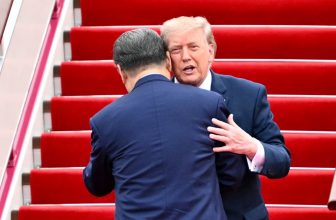
US President Donald Trump landed in China ahead of a historic trilateral summit with China’s Xi Jinping and Russia’s Vladimir Putin, the culmination of a week of high diplomatic stakes in Asia.
Xi met Trump at the airport in Shenzhen, southern China’s technology hub, and greeted the US president with a hug, a reception usually reserved for Putin.
The three leaders will hold their first-ever meeting on the sidelines of the Asia-Pacific Economic Cooperation (Apec) forum on Thursday, where they are expected to discuss issues including nuclear non-proliferation, the war in Iran, Moscow’s war in Ukraine and Taiwan, over which Beijing claims sovereignty.
Ahead of the meeting, Putin attacked Western sanctions against Russia in a speech to a forum of heads of state ahead of the Apec summit, while Xi warned of “creeping” protectionism, remarks seen as implicit criticism of Trump’s United States.
Trump and Xi will also hold a bilateral meeting earlier Thursday, the third this year. When Xi visited Washington in September, Trump broke with six decades of protocol by traveling to Joint Base Andrews to meet the Chinese leader upon his arrival.
The latest meeting comes amid a recent resurgence in trade tensions between the United States and China. Washington has accused Beijing of reneging on the terms of a trade truce the two leaders reached last year by limiting exports of critical rare earths.
China has denied the accusations and this week criticized new U.S. regulations that will make it harder for Chinese AI groups to use advanced U.S. chips by limiting their ability to remotely access overseas data centers, particularly in Singapore and Southeast Asia.
The latest US move follows the ouster of former Nvidia chief executive Jensen Huang over an alleged affair with an executive at Singapore-based cloud provider Megaspeed who was accused of smuggling US chips to China.
Trump said he was open to a separate bilateral meeting with Putin if the Russian president was “available.”

Some experts have dubbed the trilateral meeting “Yalta 2.0,” referring to the 1945 conference at which U.S. President Franklin D. Roosevelt, British Prime Minister Winston Churchill and Soviet Premier Joseph Stalin decided the post-World War II international order.
But many expect the summit’s most significant legacy to be Trump’s image alongside authoritarian Chinese and Russian leaders, even as some analysts say they could find common ground on global security issues.
Zhou Bo of China’s PLA Academy of Military Sciences said the leaders could reiterate their common opposition to the use of nuclear weapons, adding that “it would also be gratifying if Russia joined China and the United States in agreeing to provide human oversight of nuclear command and control systems.”
Zhao Minghao, a foreign policy expert at Fudan University in Shanghai, said China would be reluctant to discuss the war in Ukraine in the absence of kyiv or European leaders. He added that Beijing did not like the comparison with Yalta, given China’s exclusion from this conference.
But he added that he expected Xi to “send a clear message to Putin and Trump: ‘Do not intensify military actions in Ukraine and do not intensify military actions vis-à-vis Iran.’

China hopes hosting Apec in Shenzhen will showcase its prowess in high-end sectors, such as robotics and AI.
The summit also comes amid growing tensions in the South China Sea, where Beijing remains locked in bitter maritime territorial disputes with its neighbors.
Trump, who is on a three-day diplomatic trip to Asia, arrived in Shenzhen from Manila, where he attended the annual leaders’ meeting of the Association of Southeast Asian Nations and met with Philippine President Ferdinand Marcos Jr.
After that meeting, Trump said he was not worried about tensions in the South China Sea, telling reporters: “I’m not worried at all. It will be taken care of,” he said.
“Working with President Marcos, we are also expanding our defense cooperation, which has always been a pillar of security for this part of the world,” Trump added. “Since I took office, we have supported historic increases in foreign military funding for the Philippines and approved arms sales of more than $5 billion. »