Each night, as sleep sets in, you fly away to a place known to no one else.
While you are gone, the nightly brainwashing cycle begins.
Waves of cerebrospinal fluid (CSF) flow over and through your brain, removing waste and harmful substances and helping to refresh you to face another day.
These fluid flows – which can also occur when we are awake – are vital for brain health, with research showing that disruptions in CSF flow are linked to diseases such as Alzheimer’s and Parkinson’s.
“Removing brain waste is very important for Alzheimer’s disease and other forms of dementia, which are caused, in part, by the buildup of molecules like amyloid and tau in the brain,” says neuroengineer Joshua Levitt, formerly of Boston University and MIT, and now co-founder and CTO of neurotech startup CereBloom.
“If we can improve the removal of brain waste, we may be able to help prevent the buildup of these plaques that lead to disease.”

In a recent study published in Scientific translational medicineLevitt and his fellow researchers discovered a way to increase CSF flow during sleep, using carefully timed bursts of generated noise.
When CSF flows through the brain during non-rapid eye movement (NREM) sleep, the flows correspond to slow waves of neuronal activity visible by electroencephalography (EEG).
In their experiment, the researchers studied 14 healthy adults, aged 18 to 52, who successfully fell asleep during an MRI scan.
MRI was able to detect the flow of CSF while they slept, and EEG headsets worn on their heads monitored the accompanying neural waves.
By emitting very brief bursts of pink noise – similar to the fuzzy static of white noise, but softer and deeper, due to a different balance of frequencies – that were precisely timed to coincide with the peaks of the brain’s slow electrical waves, the researchers were able to enhance neuronal activity.
But that’s not all they saw.
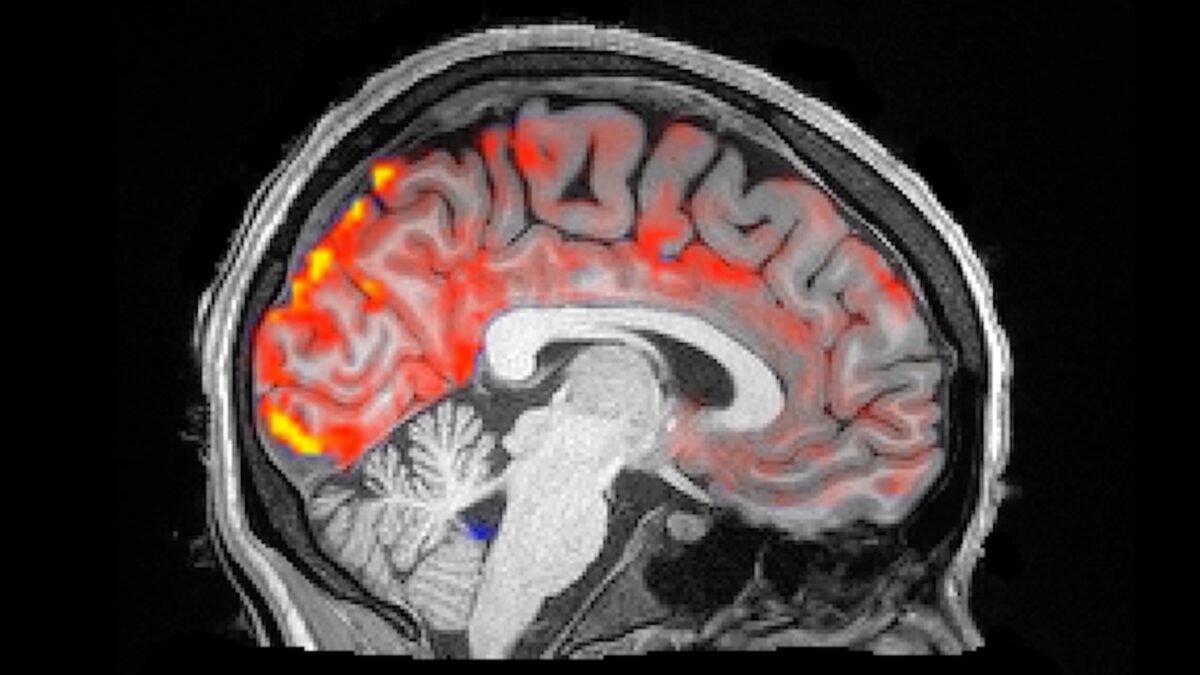
“We found that we were able to increase the size of the CSF flow wave during sleep, which, to our knowledge, there was no method to do until now,” says Laura Lewis, a neuroscientist at MIT.
This is an important finding because previously it was unclear whether there was a causal link between slow neuronal waves and CSF flow.
From these results we know that yes, and furthermore, we know that the relationship can be manipulated to increase the strength of the flow.
“Now that we can improve CSF flow during sleep in healthy adults, we’re really excited to bring this technology to clinical populations to see what effects we can have,” Lewis said.
It should be clarified that although the study demonstrates that CSF flow can be increased, it is only a small experiment and, at this time, we do not know for sure whether increasing CSF flow produces real benefits for brain health, as this has not been measured.
But if so, it opens the door to all kinds of possibilities and could possibly change the definition of a good night’s sleep.
“These results establish a causal link between the neural dynamics of sleep and CSF flow and provide technology that can now be used to modulate CSF flow and directly image the effects of closed-loop neurofeedback on the human brain,” the team explains.
“We anticipate that this approach could then be explored to understand how large-scale CSF dynamics affect brain function and to test whether this process can be modulated in aging, neurodegeneration and sleep disorders.”
The results are reported in Scientific translational medicine.
This article was fact-checked by Fiona MacDonald and edited by Fiona MacDonald. Although we are proud of our process, we are only human. If you spot an error, please let us know.
Gn Health