Fiona, the hippopotamus whose premature birth and fight for survival at the Cincinnati Zoo made her a global sensation nearly a decade ago, died Thursday from complications after swallowing a knit hat accidentally thrown into her enclosure more than a week ago.
“It is with extreme sadness that we share with you the devastating news that Fiona did not survive after multiple attempts by our incredible team of veterinarians and keepers to help her through what turned out to be a medical emergency,” the zoo said in a statement.
The zoo said Monday that Fiona was receiving 24-hour care after swallowing the hat more than a week ago.
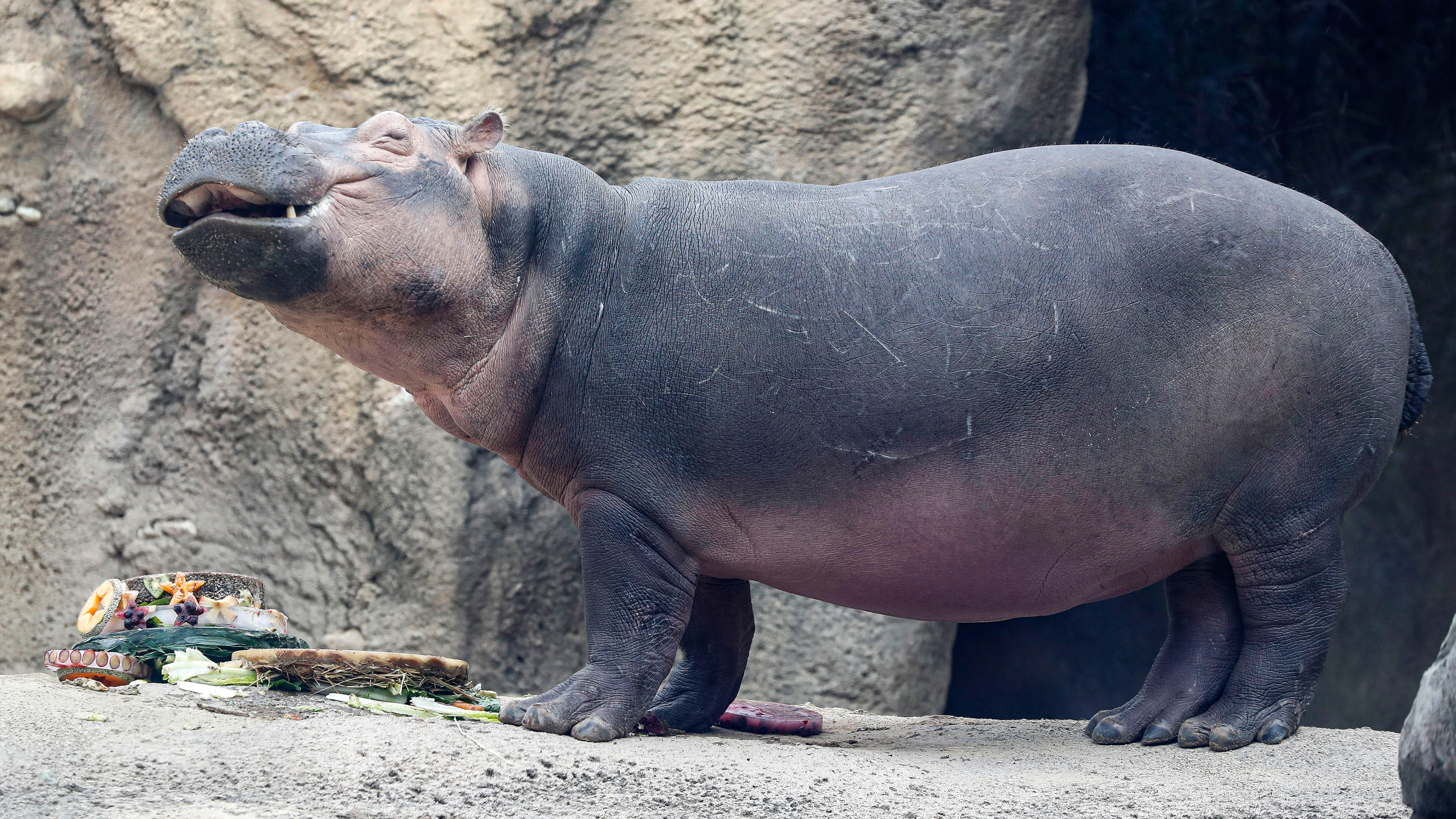
Fiona, a Nile hippopotamus, eats her special birthday cake to celebrate her third birthday at the Cincinnati Zoo and Botanical Garden, Thursday, Jan. 23, 2020, in Cincinnati
AP Photo/John Minchillo, file
Before her death, veterinarians kept Fiona hydrated, gave her treats and monitored her every move, the zoo said. They even borrowed a vibrating plate from a horse farm, encouraging him to stand on it several times a day in the hopes that the shaking would help move things through his digestive tract.
Grace Brooks of Cincinnati and her two children, ages 3 and 5, had Fiona on their minds when they arrived at the zoo Thursday, before news of her death broke. Her children talk about Fiona in kindergarten, she said.
“They said she needed to poop, which is true, you know,” Brooks said with a laugh. “They know everything about Fiona and we have a lot of books about her.”
The zoo was mostly empty, although a small crowd was gathered inside “Hippo Cove,” where two other hippos were swimming.
Even without Fiona in the cove, her presence was felt. There’s a holiday-themed Fiona statue right outside the entrance, and the gift shop has an entire wall filled with hippo-themed shirts, coffee mugs, shot glasses, and books, including “A Very Fiona Christmas” and “You’ve Got This, Fiona.”
Fiona was under close surveillance
Fiona captivated people around the world after her premature birth in 2017. She swallowed the hat about 11 days ago after a zoo visitor threw it into the air. A ceiling fan caught and catapulted the hat through a small opening above the area’s observation windows.
It was an accident, zoo spokeswoman Michelle Curley said.
Before her death, Mike Wenninger, the zoo’s director of animal health, said veterinarians sedated her twice to assess her condition.
On Tuesday, an ultrasound showed swelling in her intestines, indicating she was still trying to get past the obstruction, Wenninger said. They also performed a colonoscopy using a 9-foot telescope, but couldn’t detect anything, he said.
“Her care team even offered to sniff coffee, a flavor she always loved,” Curley said Wednesday in the latest update on Fiona’s condition. “And they were happy to see her respond.”
Surgery would be a challenge
Specialists told the zoo that surgery was not an option for adult hippos, the zoo said.
Hippos have digestive systems that would make Fiona’s situation tricky, Jack Kottwitz, an assistant professor at Michigan State University’s College of Veterinary Medicine, said before her death was announced.
“They have a multi-chambered stomach for digesting plants – much like a cow – but they don’t regurgitate or ruminate like a cow. These multiple chambers, folds of tissue, liquids and easily digested foods ‘hide’ the cap, making removal with an endoscope of the stomach chambers very difficult,” Kottwitz told The Associated Press in an email.
The surgery poses a major logistical challenge for many reasons, he explained.
In order to find the hat, several incisions might be necessary during a very long operation, he said. But hippos are notoriously difficult to anesthetize and in places have skin more than 5 centimeters thick. Hippos also really need access to water, and Fiona should stay out of water for several days after surgery to allow the incisions to heal, he said.
“Since there is no reliable way to determine whether the cap is in the stomach, intestine or colon, surgeons may have to carefully explore the entire digestive tract – stomach, intestine and colon – to find it,” Kottwitz said.
Jan Hawkins, a doctor of veterinary medicine at North Carolina State University, said Fiona’s situation was difficult because it was hard to tell exactly where the hat was.
“You just don’t know because you can’t do the normal imaging and things that you can do in some of the smaller animals, or even horses,” Hawkins said.
Other zoo animals have also died after eating foreign objects. Zoos around the world have been warning for years about the dangers posed by objects thrown or blown into animal habitats.
Two years ago, a rare antelope suffocated to death after eating the plastic lid of a squeezable fruit bag at a Tennessee zoo. A polar bear at a German zoo died in 2014 after swallowing a jacket left in its enclosure by a visitor.
Veterinarians say pet owners often make emergency visits after their dogs swallow balls, toys and string.
Fiona became a sensation after Harambe’s death. Fiona survived her first health problem when she was born six weeks premature. She weighed only 13.2 kilograms, which was below the lowest birth weight recorded for her species at that time.
Fiona was unable to breastfeed, so a zoo worker milked her mother by hand. The zoo recorded his progress with photos and videos, while fans around the world followed his progress online.
His survival brought an encouraging twist to the Cincinnati Zoo after months of backlash following the shooting of Harambe, the gorilla who became a pop culture phenomenon after being killed because a child entered his enclosure.
Copyright © 2026 by Associated Press. All rights reserved.
Gn headline