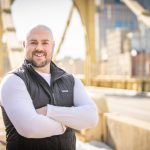

Abdelrahman ElGendy won the Non-fiction prize at the National Book Awards for his memoir, Huna.
Fadel Dawod/National Book Foundation
hide caption
Fadel Dawod/National Book Foundation
Writer Abdelrahman ElGendy won this year’s non-fiction prize at the National Book Awards for his book Huna. The memoir looks back on the six years he spent as a political prisoner in Egypt. But ElGendy was not present to accept the award.
In an essay published in The New Yorker last week, he wrote that he could not attend the ceremony because his visa to enter the United States from Europe had been denied. The article raised questions about his eligibility for the award. The National Book Foundation released a statement just hours before the ceremony, saying it had expanded eligibility criteria in 2024 and was “proud to celebrate” Huna“.
Helen Thomaides, editor-in-chief of ElGendy, accepted the award at the ceremony in New York and read a statement on behalf of ElGendy. “Years ago, in my prison cell in Egypt, I fantasized about writing my memoir,” he wrote. “Today, this dream should have come full circle. But like so many broken circles in my life, it will remain unfinished, broken by an oppressive regime with fascist ideology.”
The novelist Hannah Lilith Assadi won the Fiction prize for her novel Paradise 17. The book follows Sufien, a Palestinian traveling the world after being exiled from home in 1948. In her acceptance speech, she spoke about the book’s origins on her Palestinian father’s deathbed. “I saw cancer ravage my father’s body, and genocide ravage his people and his children,” she said. “And this is perhaps the Palestinian story on this Earth. So beautiful, so painful. And isn’t this story ours.”
Brenda Hillman won the poetry prize for her book Another house in the Desert: An eco-contemplation. The book is a meditation on returning to one’s childhood home after the death of one’s mother. In his acceptance speech, Hillman thanked everyone who has ever written a poem and argued for poetry’s place in the literary landscape and in everyday life, urging press and critics working on year-end best-book lists to keep poetry in mind.
The Translated Literature Prize was awarded to Spanish author Vicente Luis Mora and translator Rahul Bery for the book Centroeuropa. The stylistically experimental novel centers on a 19th century man who attempts to bury his deceased wife and, while digging in the earth, finds soldiers from different eras and wars.
And the children’s literature prize was awarded to The Fight of Our Lives: AIDS in America by David Levithan and Gabriel Duckels. The non-fiction book is a history of HIV and AIDS and the popular response to the AIDS crisis.
The National Book Foundation also presented two lifetime achievement awards to pediatrician and literacy advocate Perri Klass and author Salman Rushdie. Klass, who worked with clinics to give books to children during their visits, accepted her award by bringing a stethoscope and a copy of Good night Moon to the stage.
Rushdie took time in his acceptance speech to pay tribute to science fiction author and fellow National Book Award Lifetime Achievement winner Ursula K. LeGuin. “When my first novel was published 51 years ago, it was widely criticized. But Ursula LeGuin loved it,” he said. “She was pretty much the only one who did it. And that meant everything to me.”
Actor Kyle MacLachlan hosted the show. He opened the proceedings by talking about his lifelong love of books and joking about AI and not reading all of the nominated books.
Gn entert