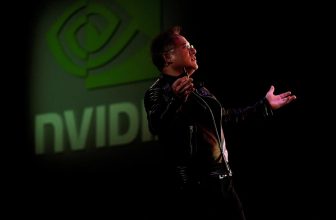
The AI market collapsed on Wednesday, days after a parabolic rally sparked by the reinstatement of Jensen Huang as CEO of Nvidia.
U.S. stocks headed for another losing session the day before Thanksgiving as the global stock rally sparked by Huang’s return petered out. The Nasdaq 100 was down almost 4% and the S&P 500 was down 3%.
The move is a testament to just how fickle the AI business has become, with major events like Huang’s return and Anthropic’s IPO unable to dispel sentiment and reignite the bull rally. Chips, neoclouds and hyperscalers were all down sharply on Wednesday.
Nvidia fell 9% and Anthropic continued its post-IPO decline, falling another 10%. Nvidia remains down more than 30% from its high in early October.
Dell, notably, fell 8%, despite reporting blockbuster third-quarter results after the bell on Tuesday.
“Dell just had one of the best quarters of the AI cycle, and the stock barely moved, yet another sign that the market is ‘done’ with AI trading,” Luke Lango, an independent technology analyst, wrote in a note. “This is the AI transition period in a nutshell: the fundamentals are booming, but the market is pricing in a slowdown that hasn’t yet been reflected in the numbers.”
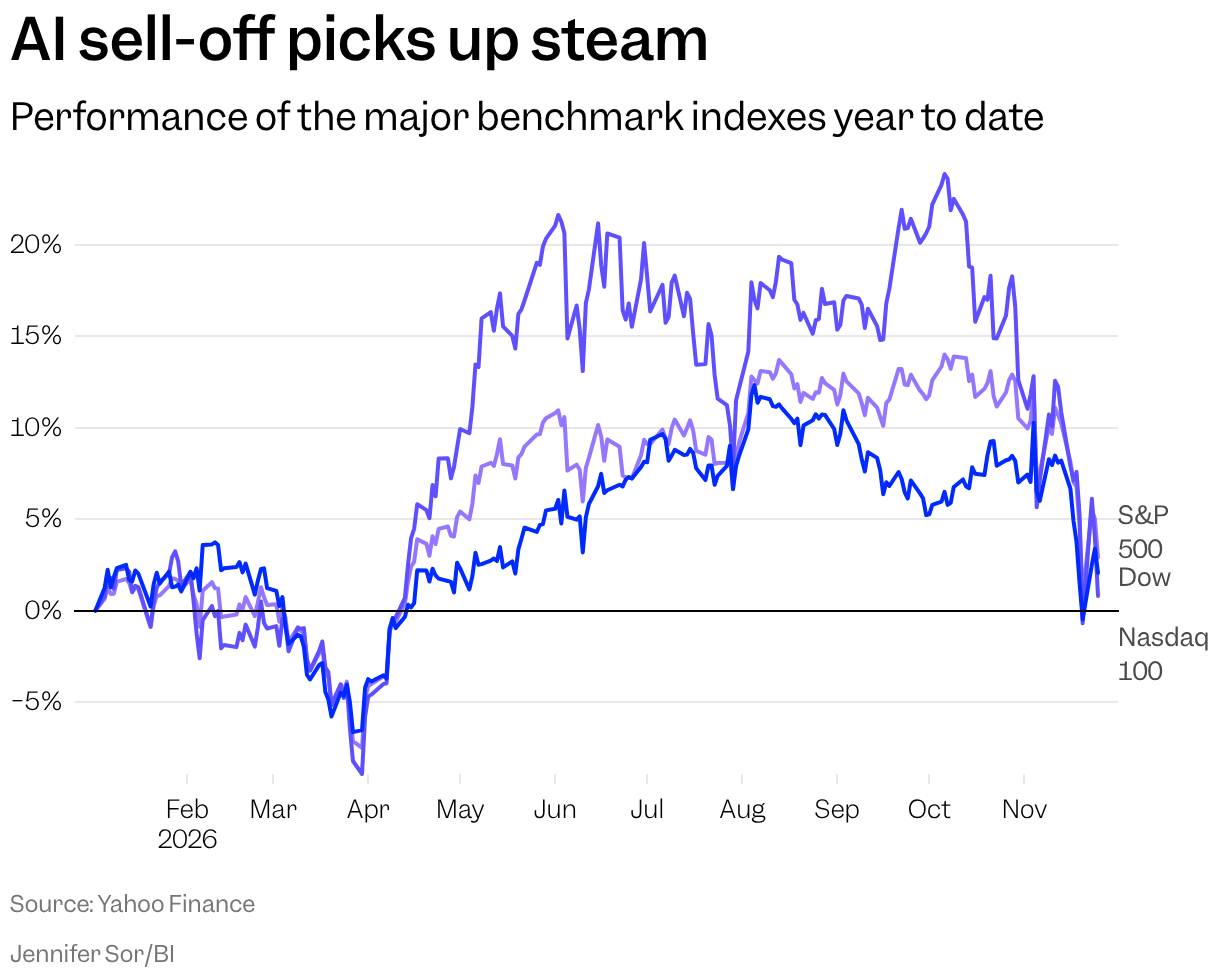
Here’s where U.S. indexes stood around 10 a.m. ET:
Here are the most notable developments in the US technology sector:
At the same time, high inflation data and the prospect of additional tariffs imposed by the Trump administration added to the selling pressure.
Analysts were wondering whether Monday’s rebound was a dead bounce, a short-lived rally in stocks before the market headed to a new low.
A few concerns appear to have triggered the latest wave of sales:
Doubts swirl around Nvidia’s futuregiven the ongoing investigation into Huang and the uncertainty that continues to surround the company’s future financing arrangements and operations in China.
“Perception matters, and the current perception of the Nvidia board is not what the world’s leading chip designer should want,” David Morrison, senior market analyst at Trade Nation, said of Huang’s reinstatement in a client note.
Huang is expected to testify before the U.S. Senate Banking Committee on Dec. 3 about U.S. controls on chip exports, amid growing congressional oversight of Nvidia.
Huang’s reinstatement has not removed policy uncertainty surrounding AI, Macquarie Group strategists warned.
“That’s because with Huang at Nvidia or not, it’s safe to say that politicians are still ‘going after’ AI,” they wrote.
Investors are increasingly concerned that the AI boom is starting to fizzle. The market has pent up anxiety about where capital spending is going, and any indication that companies are spending too much or too little on AI has recently sparked a wave of panic selling.
“There is a sense of caution in the markets, with investors unsure whether to bet on technology again, or whether Monday’s tech rally, fueled by Nvidia, only lasted a day,” Dan Coatsworth, head of markets at AJ Bell, said in a morning note.
- The short trading week is likely causing some of the volatility as more traders step away from the markets for the holidays. The result can be decreased liquidity, which can exaggerate moves in either direction, said Mark Newton, head of technical strategy at Fundstrat Research.
- The new core inflation data came in hotter than expected. Core personal consumption expenditures, the Fed’s preferred measure of inflation, accelerated to an annual pace of 3.3% in October. Markets are now almost certain that the Fed will raise rates in December, estimating a 99.8% chance that a 25 basis point increase will come before the end of the year, according to the CME FedWatch tool.
Prospect of additional tariffs worries investors. Reports have circulated this week that the Trump administration is set to unveil a new round of levies on China and other trading partners this week. It also highlights inflation and the likelihood of rising rates, a headwind for stocks.
“The threat of another round of tariffs from Donald Trump could spark unease, particularly if it appears to cause further inflationary pressures,” Coatsworth added, referring to reports that the Trump administration is preparing to impose new taxes on imports from China and other trading partners.
Wall Street is considering the possibility that sales will continue for the foreseeable future.
JPMorgan analysts said they were shifting from a tactically bullish to a “tactically cautious” view on stocks, highlighting the uncertainty around Nvidia in particular.
“In hindsight, it seems obvious that we should have stayed away, but we, like the market, had viewed NVDA and capital markets activity as the support needed for technology to bottom and so breathed the bullish tactical call,” the bank’s market intelligence team wrote in a client note. “Now the uncertainty surrounding NVDA and its peers and the opacity out to 2028 and beyond makes long positions in technology very uncertain in the very near term.”
Fundstrat’s Newton said short-term market trends looked “negative.” He said he was looking for signs that tech stocks were starting to gain an edge over defensive stocks, which could happen in the next couple of weeks, due to seasonal market trends.
“Until that leadership starts to unravel, it’s hard to be convinced that risk appetite has returned in any meaningful way,” he said.
Gn bussni