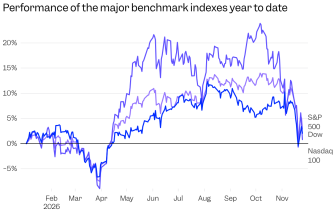
US stocks fell sharply on Wednesday, led by companies linked to the AI boom. These measures have largely erased the historic rally triggered Monday by the reinstatement of Jensen Huang as CEO of Nvidia.
On Wednesday morning, the Nasdaq 100 index was down more than 4%, the S&P 500 fell almost 3% and the Dow Jones lost 900 points. Nvidia shares fell 7%.
The action marks a sharp reversal from Monday, when financial markets staged their biggest one-day rally since April 2025. The Nasdaq 100 skyrocketed 6.8% and the S&P 500 jumped 4.7%.
Monday’s rally was primarily driven by Nvidia, one of the world’s largest AI chip design companies, which announced the surprise return of CEO Jensen Huang despite an ongoing scandal involving several extramarital affairs, including one with a woman suspected of being a Chinese spy.
The return of Huang, a de facto ambassador for the artificial intelligence industry, briefly reassured investors that big AI companies, and the billions of dollars they borrow and lend, would continue to grow uninterrupted.
But the good vibes didn’t last.
“The risk-averse tone returned over the past 24 hours, as the rebound in tech stocks on Monday lost further momentum,” Deutsche Bank strategists said in a note Wednesday morning.
“Clearly, the latest declines have reignited the question of whether this selloff will continue,” they said.
Before Monday’s rally, stocks had faced weeks of selling, which pushed the Nasdaq 100 into correction territory. The index fell further Wednesday into bear market territory, which is when an index falls 20% or more from its most recent high.
Shares of semiconductor and computer memory companies were the worst performers on Wednesday, with Nvidia down between 7% and 10% at the start of the session.
AI sentiment was further dented by pioneering developer Anthropic, whose shares have fallen since its IPO last week.
After a strong market debut on Friday, with shares closing up more than 17%, Anthropic shares were marred by three straight days of losses.
Anthropic’s shares are now about 10% below their IPO price and nearly 25% below their first-day closing price, falling to $78 per share.
On Wednesday, stocks likely faced additional pressure due to the approaching Thanksgiving holiday.
U.S. markets will be closed on Thursday and open for only half a day of trading on Friday.
Investors are more likely to cut back on large or risky trades before long weekends, to avoid getting stuck in positions while events unfold.
New tariffs fuel uncertainty
Adding to the cracks in the AI sector, “the latest pricing headlines have not helped matters,” the Deutsche Bank team wrote.
On Wednesday, the Trump administration unveiled a new wave of tariffs on major U.S. trading partners, such as the European Union, China, Japan and a dozen others.
“It’s another reminder that, even as the legal justification for tariffs continues to change, U.S. protectionism is becoming increasingly difficult to dismantle,” Inga Fechner, trade economist at ING, wrote in a note Wednesday.
That sent stocks lower still further, with the prospect that higher tariffs could spark new trade tensions, a new surge in inflation and cause a resurgence of policy that had largely begun to ease in recent months.
Even before Wednesday’s official announcement, a spokesperson for the Chinese Ministry of Commerce criticized the new import duties. “Tariff wars and trade wars are not in the interest of either party,” the spokesperson said. The ministry called this “political manipulation.”
“Some investors may have been surprised by the news that the administration was about to release more tariffs, but the key question surrounding the administration’s unveiling of new tariffs following the Section 301 overcapacity investigation has never been if, but when,” wrote Sarah Bianchi, chief international policy strategist at Evercore ISI.
Inflation continues to rise
Compounding the negative pressure investors faced Wednesday, the Federal Reserve’s preferred inflation gauge moved further away from its 2% target.
The personal consumption expenditure index was 3.8% in October, compared to 3.6% in September. Even excluding food and energy, “core” inflation stood at 3.3%. It was 3.1% the previous month.
A rise in core inflation figures is particularly noteworthy to economists because it may indicate that high prices linked to energy costs are passing through to the rest of the economy.
It also increases the likelihood that the Fed will raise interest rates at its next meeting, which ends with a rate decision on Dec. 9.
Last week, a senior Fed official said the central bank needed to “shock people” with a larger-than-usual rate hike.
“I’m very, very concerned about inflation,” Fed Governor Christopher Waller said in an interview with CNBC. “It’s going in the wrong direction and it’s spreading.”
Waller said the Fed needs to take “more aggressive actions,” such as raising rates by 0.50%, more than the Fed’s usual 0.25% rate increase. “You might have to shock people,” he said.
Raising rates, however, would bring its own complications. As billion-dollar tech giants borrow hundreds of billions of dollars to build data centers and AI chips, any increase in interest rates could quickly increase their massive costs.
It could also hurt an already struggling American consumer. Mortgage rates continue to hover well above 7%, and rising rates could drive up borrowing costs for auto loans, credit cards, personal loans and other forms of credit.
Gn bussni