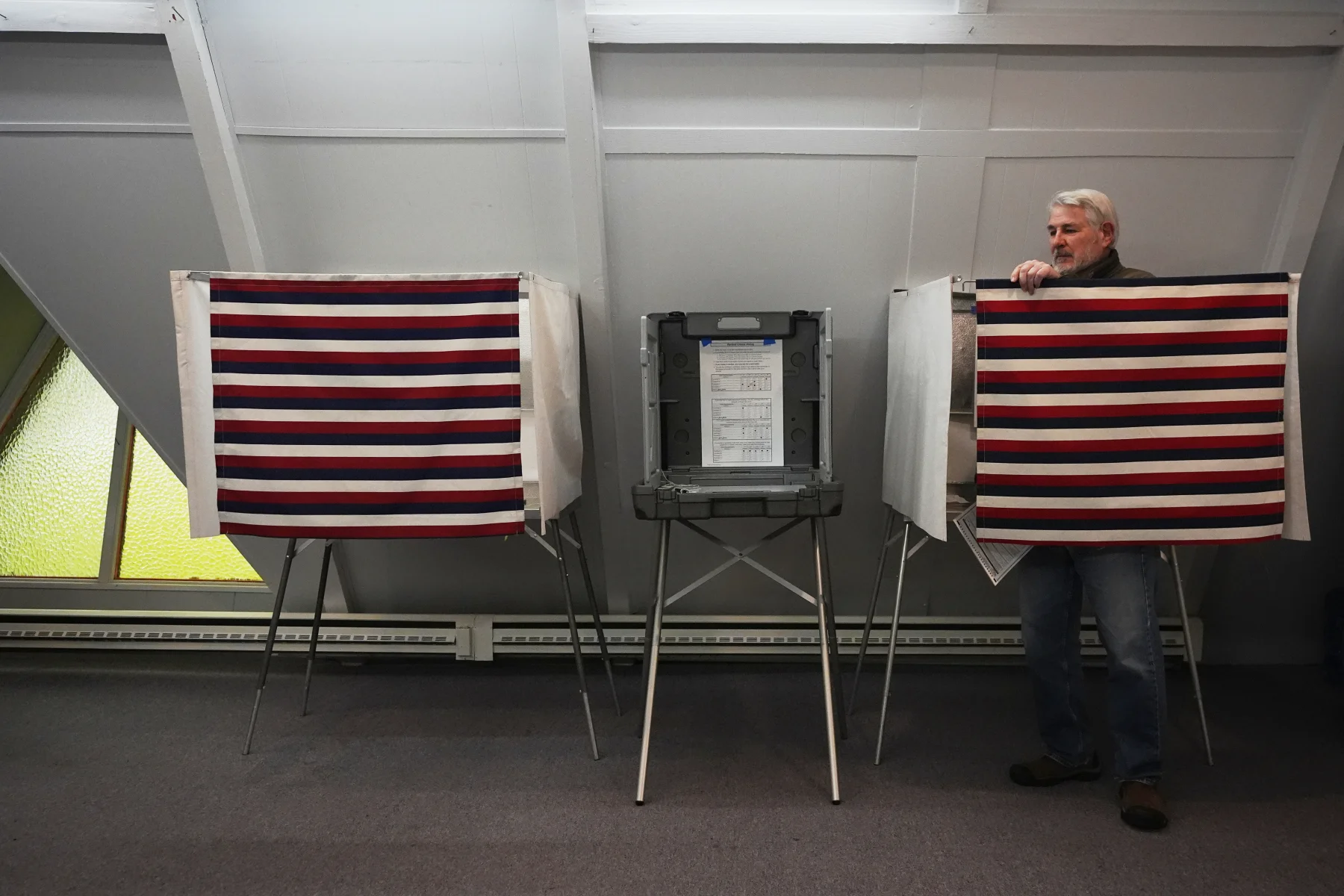
A voter enters a booth at the Valley Bible Chalet to vote on Election Day, November 3, in Indian, Alaska.
Lindsey Wasson/AP
hide caption
Lindsey Wasson/AP
A ballot measure that would have repealed Alaska’s nonpartisan primary system and ranked-choice voting has failed, according to a call for a night race by The Associated Press.
This is the second time Alaskans have voted against an attempt to repeal the state’s unique election system, which voters first approved in 2020. A repeal attempt in 2024 also narrowly failed.
This year, however, Alaska’s system has come under national scrutiny, due to the inclusion of two candidates with the same name on the four-person U.S. Senate general election ballot. This race seems likely to move to a pick-and-choose ranking.
“Alaskans of all political stripes have spoken: They want the freedom to vote for any candidate, regardless of party, in every taxpayer-funded election,” Nick Troiano, executive director of Unite America, a philanthropic venture capital fund that invests in nonpartisan election reform, said in a statement before the AP call. “At a time when most general elections across the country are essentially coronations, The Last Frontier shows that a better path is possible. It’s time to honor the voters’ decision and move forward.”
Only a few states have nonpartisan primary systems that allow voters of all political affiliations to vote on the same primary ballot. While California and Washington’s systems allow the top two vote-getters to advance to the general election, Alaska’s system allows the top four candidates to move on. Then, if no candidate receives a majority of votes in the general election, ranked-choice voting is used to determine the winner.

Opponents of Alaska’s elections say the current system is confusing and open to manipulation.
These opponents have seized on this year’s closely watched Senate race, in which an independent candidate named Dan Sullivan was reportedly a Democratic-backed spoiler recruited to siphon votes destined for the Republican incumbent, also named Dan Sullivan.
Democrats denied recruiting independent Sullivan, who placed in the top four in the general election and championed his candidacy.
However, supporters of Alaska’s system said the state’s ranked-choice voting system could mitigate the effects of any confusion. Voters had the option of ranking both Dan Sullivans and not Democrat Mary Peltola, for example.
Massachusetts voters decided this year not to move to a nonpartisan top-two primary system. And during the last election cycle, in 2024, several states considered measures that would create a nonpartisan system similar to Alaska’s. Voters rejected all of these ballot measures.
Gn usa