

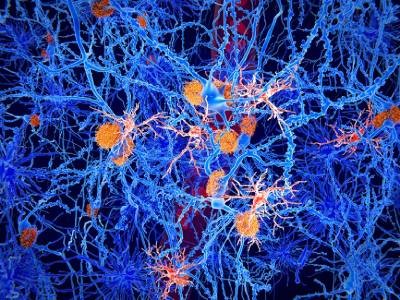
Screening mouse hippocampal cells (pictured) identified an enzyme whose production increased with age. Credit: Talley Lambert/Scientific Photo Library
An enzyme in the brain may help preserve cognitive resilience as we age, according to research in mice, humans and cells.1.
Researchers found that high levels of the enzyme are linked to low levels of inflammation in the brains of aged mice. They also showed that the enzyme stimulates neuron growth in aging brains. The results were reported October 15 in Natural neuroscience.
The enzyme appears to act “as a compensatory mechanism for cognitive resilience,” explains study co-author Amar Sahay, a neuroscientist at Massachusetts General Hospital in Boston.
“This is a fantastic, very thoughtful approach to figuring out what might protect neurons,” says Timothy Hohman, a neuroscientist and geneticist at the Vanderbilt Memory & Alzheimer’s Center in Nashville, Tennessee, who was not involved in the study. “It’s a great example of how you can use a model system to understand some of these resilience mechanisms that are very difficult to study in humans.”
A new neuroprotectant
The enzyme in question is a phospholipase, which breaks down fatty compounds. The authors became interested in the enzyme after discovering that the gene that encoded it suddenly became more active when the connections between certain neurons in the mice’s brains were disrupted.

How to avoid dementia – what the science really says
To find out more, scientists genetically modified mice to lack the gene, called Pla2g2fand I watched what happened as they got older. The researchers found increased inflammation and neuron degradation compared to the brains of unaltered control animals. On the other hand, mice which presented an excess Pla2g2f displayed less inflammation and better connected neurons in their brains as they age.
The team also tested the animals’ spatial memory. These results also suggest that the enzyme provides protection. Middle-aged mice that were missing Pla2g2f lower scores on memory tests compared to middle-aged control mice; older animals with boost Pla2g2f performed higher on the test than older control mice.
These results show that Pla2g2f can be used to modify the trajectory of pathological aging in mice, adds Sahay.
Human genetics
The gene could also have a protective role in humans. The authors analyzed two large datasets2 compiled by other scientists and found that PLA2G2F Human brain activity increases with age.
Sahay collaborated with researchers who had collected data on gene expression4 from the brains of deceased human donors. The donors had all undergone cognitive testing before their death. Sahay’s team discovered that PLA2G2F Activity was highest in “resilient” individuals, that is, people whose cognition remained intact even though their brains contained deposits of a protein called amyloid-β. Such deposits are a hallmark of Alzheimer’s disease.
Brain cells linked to protection against dementia
Gn Health

