

The U.S. Disciplinary Barracks, where Nidal Malik Hasan is being held on death row, is visible at Fort Leavenworth, Kansas.
Paul Hennessy/SOPA Images/LightRocket via Getty Images
hide caption
Paul Hennessy/SOPA Images/LightRocket via Getty Images
American public opinion toward the death penalty has returned to the forefront after President Trump gave his blessing, then reversed course, to livestream an execution by firing squad.
The planned execution comes after two botched lethal injections in Tennessee this year, where the state struggled to find veins to administer lethal drugs to Christa Pike and Tony Carruthers.
Speaking at a news conference a day after Pike’s failed execution, Tennessee Gov. Bill Lee said Tennessee residents were disappointed in what happened.
“The people of Tennessee have determined that the death penalty is an appropriate punishment for the most heinous crimes committed in this state,” he said. “The people of Tennessee make that decision and my job is to make sure those sentences are carried out.”
These Tennesseans join About two-thirds of Americans support the death penalty for people convicted of murder, according to a Pew Research Center poll conducted this summer. According to PRRI, a nonpartisan nonprofit organization, people in favor of this punishment tend to be Christian, white and vote Republican.
Daniel LaChance, a history professor at Emory University, says the overall numbers mask a wide range of opinions.

“In the United States, support for the death penalty runs a mile,” says LaChance, who also wrote the book “Executing Freedom: The Cultural Life of Capital Punishment in the United States.”
That’s because polling is incredibly nuanced, LaChance said. While polls offer more diversity in issues, such as life without parole, 60 percent of Americans support that idea over the death penalty. This figure drops even further when financial assistance to victims’ family members is an option.
And another 2025 Gallup poll – which tracks support for the death penalty since 1937 – shows that 52% of Americans support the death penalty if a person is convicted of murder, the lowest proportion in more than 50 years.
The change in public opinion
The Death Penalty Information Center, a nonprofit organization that tracks the use of the death penalty but takes no position on it, has counted 203 people since 1972 who have been exonerated after being wrongly convicted and sentenced to death.
“These are just the ones we know,” says Robin Maher, executive director of the nonprofit. “We do not know how many innocent people were executed before learning of their allegations.”

It is wrongful death sentences, and their moral effectiveness, that influence public opinion, Maher said.
“The public’s realization that the death penalty system was fallible, that it made serious mistakes, raised many questions in people’s minds about whether this very expensive public policy, which was nevertheless rather inaccurate and unjust, should be used,” Maher said.
The July Pew Research Center study also found that while most people support the death penalty for crimes like murder, about 59 percent of respondents said the death penalty does not deter people from committing serious crimes — compared to 39 percent who think it does.
Six states are responsible for the 31 executions that occurred in 2026, even though 27 states still legally allow the harshest form of punishment there. Florida leads the way, with more than half of the executions this year.
Maher says the fact that more than half of states allow the death penalty, but impose fewer death sentences, shows that the American people are disenchanted with the use of the death penalty.
“More often than not, they find that it’s not the right answer to violent crime,” she said. “Executions, on the other hand, are the result of what a handful of elected officials do in just a few states.”
Texas has had the highest number of executions since the 1970s, while Michigan holds the title of having the longest abolition of the death penalty in the United States, having banned the practice in 1847.
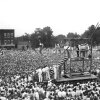
Out of public view
The planned execution by firing squad is that of Nidal Hasan, the former Army psychiatrist stationed at Fort Hood, Texas, who killed 13 people and injured 32 in 2009. It is scheduled for December but appeals could delay it further.
While 52% of Americans support the execution of Fort Hood shooter Nidal Hasan, 80% say his death should not be broadcast live, according to an October poll by ABC News/Washington Post/Ipsos.
When Defense Secretary Pete Hegseth announced earlier this month Although Hasan would be publicly executed, the United States had also not carried out a large-scale public execution in 90 years.
In some parts of America, quasi-public executions have drawn as many as 10,000 spectators in the past, said LaChance, a history professor at Emory. But the increasing use of drugs such as anesthesia has started a negative trend in public executions.
“Pain, especially in public spaces, is starting to seem outrageous,” LaChance says. “It’s avoidable now. It’s starting to seem barbaric.”
LaChance also said the public, especially in immigrant communities, would turn the executed into heroes. “They were demanding the body and having small parades in Lower Manhattan, celebrating the life of the person who had been put to death,” he said.

A U.S. official who spoke to NPR on condition of anonymity for fear of retaliation said President Trump was dissuaded from a live execution because it went against American values — but also because there were concerns the tape would appear on jihadist websites, leading to an increase in recruits and possible danger to U.S. forces in the Middle East.
“It’s the history of the death penalty,” LaChance says. “People didn’t want public executions to disappear. The elites did it because they became embarrassing carnivals.”
Gn headline

