British Jewish actor Sacha Baron Cohen, whose “Ali G: Who Iz I?” debuted Friday, suggested that calls to boycott the film about the aspiring black rapper he plays is an example of how “Jews are being targeted.”
“We’re in a world where people can’t distinguish between facts and lies, and that’s something I’ve spent a lot of the last few years trying to resolve,” Cohen told The Hollywood Reporter in an interview published this week, citing his activism against racism on social media.
“So I’m not surprised that prominent Jews are being targeted. I knew this was going to happen. The level of organization is surprising, but this is a trend of Jews being portrayed in a certain way and trying to be silenced,” he said.
Cohen, who lived in Israel as a teenager and speaks fluent Hebrew, also denied speculation raised by his interviewer that calls to boycott Ali G’s new film were linked to his “pro-Israel stance.”
“I didn’t say anything about Israel,” interrupted Cohen, who called for the release of Israeli hostages after the Hamas attack on October 7, 2023, but otherwise refrained from any public statements on the war in Gaza.
Asked if he “felt a difference” in his own career amid the global rise in anti-Semitism that followed the attack, Cohen said, “No, not really. I mean, maybe it’s because I don’t do much, but I didn’t.”
Catch me in theaters for just two days starting tomorrow in an event I’m calling “Iz It Coz I Ain’t Black Friday”, buy them now pic.twitter.com/KQHSGatdWM
— Ali G (@OfficialAli_G) October 22, 2026
In another public appearance promoting the film, Cohen revealed that the production team for the Marvel Cinematic Universe 2025 miniseries “Ironheart” was hesitant about casting him as the evil Mephisto due to Jews’ anti-Semitic associations with Satan.
“They said, ‘We want to offer you Mephisto, but we are aware of the historically negative association of Jews with the devil, and we want to make sure that you are not insulted by our offer,'” Cohen said during a live taping of the Happy Sad Confused podcast in New York. “It was an incredibly thoughtful and empathetic thing to say. And I was like, ‘Yeah, I’m good.’
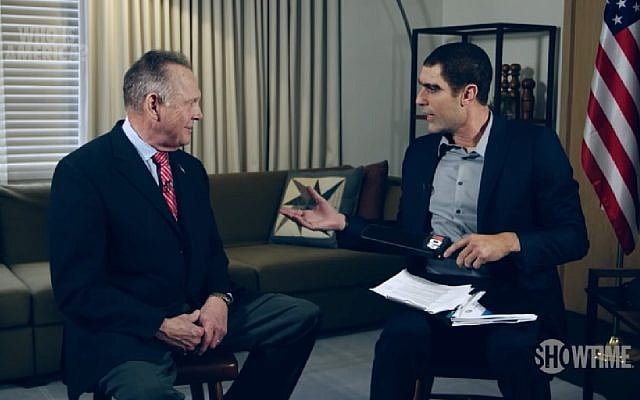
Cohen, 55, reprises the role of Ali G on screen for the first time in over 20 years in his latest film to poke fun at unsuspecting participants. The film, distributed by Amazon, also features Cohen as former Mossad counterterrorism expert Col. Eran Morrad, whom Cohen profiled in his 2018 mockumentary series “Who Is America?” »
This time around, Cohen’s victims include El Paso County Republican leader Michael Aboud, who vowed to pursue legal action after he was filmed firing bullets into his buttocks and dropping what he thought was a baby from a helicopter during a Morrad-guided mission to prevent an immigrant birth on U.S. soil.
Cohen has previously sparked controversy in similar guerrilla films featuring exaggerated caricatures such as the anti-Semitic Kazakh journalist Borat Sagdiyev and the flamboyantly gay Austrian fashion journalist Brüno Gerhard.
Ali G’s character is known for wearing stereotypical urban streetwear, affecting a faux Jamaican patois and responding to perceived slights with the catchphrase “Is it because I’m black?”
In a Time Magazine essay published this week in response to calls for a boycott, Cohen described his character as “a white fool – a delusional cultural appropriator – who steals fashion and lyrics from his favorite gangsta rap and dancehall idols, from Compton to Kingston.”
The character helped propel Cohen to fame in the late 1990s and early 2000s, but he has long been accused of appropriating black culture. These criticisms are the focus of the new film.
Before the film’s release, media monitoring site NewsCord launched an email campaign demanding that theater chains refuse to screen “Ali G: Who am I?” due to the character’s “discriminatory language”, “a sustained caricature of a white comedian from black British street culture”.
Online critics have also called for a boycott of the film, although it is unclear whether these calls have met with much success.
Jonathan Greenblatt, head of the Anti-Defamation League, criticized calls for a boycott.
“No artist should be pressured, blacklisted, or silenced because of their Jewish identity. And Jewish artists should not be subjected to ideological litmus tests,” the ADL leader wrote on X on Thursday.
My friend @SachaBaronCohen has spent years fighting hate and misinformation, and @ADL is proud of all the work we’ve accomplished together. In a world where lies spread faster than facts, this work matters more than ever.
No artist should be pressured, blacklisted or silenced for… https://t.co/eS9iO9QCQ9
— Jonathan Greenblatt (@JGreenblattADL) October 22, 2026
The pro-Israel anti-Semitism watchdog is one of several groups Cohen worked with in 2020 to found Stop Hate for Profit, an organization dedicated to pressuring social media companies to remove racist content from their platforms.
“In a world where lies spread faster than facts, this work matters more than ever,” Greenblatt wrote.
Cohen himself wrote in his Time article: “As someone who has opposed bigotry and injustice throughout his life and who has associated himself with civil rights groups, I do not identify with the distorted depictions of me that I sometimes see on social media, lumped in with the bigots I ridicule. »
“I have always conceived of my characters and comedies as vehicles for exposing prejudice, prejudice, and stupidity, although I realize that not everyone sees them that way,” Cohen wrote.


Gn entert