
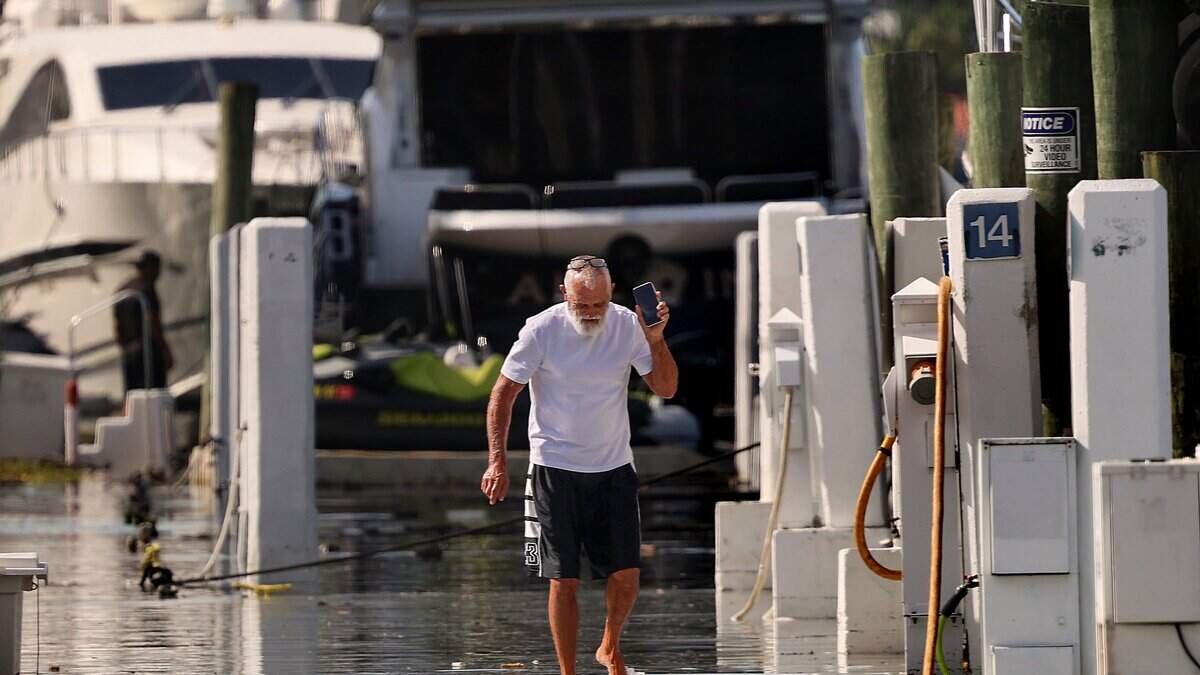
A yacht operator surveys floodwaters at the Fontainebleau Marina in Miami Beach, Florida, during a king tide Monday, September 28, 2026. The seasonal high tide caused flooding in low-lying areas of Miami-Dade County.
cjuste@miamiherald.com
Some South Florida streets and parks will likely be submerged at some point over the next few days as another round of king tides – stronger ones – hits the region.
These higher than usual high tides are accentuated by winds blowing towards the shore, pushing more seawater onto land. Add to that the 1 to 2 inches of rain expected along the coast over the next few days and you have a recipe for flooding.
“Anywhere the tide is wet, it will be made worse by rain showers,” said Donal Harrigan, a meteorologist with the National Weather Service’s Miami office.
Already, the high tide on Friday and Saturday has left coastal streets and parks soggy. But that king tide won’t peak until Tuesday, when, according to the NWS, the area could see “moderate to major flooding.” This episode of king tides began on Friday and lasts until October 31.
Saturday marked the fifth consecutive day that the Virginia Key tide gauge experienced “moderate” flooding of about 1.6 feet above sea level, “and this streak will continue for another 4 to 5 days,” Brian McNoldy, a hurricane researcher at the University of Miami, posted on Bluesky.
On Tuesday and Wednesday, the region could potentially experience “major” flooding, about 2.5 feet above normal, according to forecasts. Flooding is at its worst about an hour before and after high tide, which is expected to be:
Miami Dade: around 9 a.m. and 9 p.m. on Sunday; 9:45 a.m. and 9:45 p.m. Monday; and 10:30 a.m. and 10:30 p.m. Tuesday.
Broward: around 8 a.m. and 8 p.m. on Sunday; 9 a.m. and 9 a.m. Monday; and 9:45 a.m. and 9:45 p.m. Tuesday.
These tides are a natural and predictable event every year. But rising sea levels are pushing them higher and higher, and experts say these higher-than-usual tides provide a taste of what an average day might look like in decades to come, when the sea will be a few meters higher.
Sea level rise is accelerating. It took 80 years for the sea to rise about a foot, with 8 inches of that foot just in the last 30 years. According to forecasts, the next step could only take 30 years. After that, 20 years for the next foot.
In response to the growing threat, South Florida has invested hundreds of millions of dollars in raising roads in places like Miami Beach, maintaining storm water pipes and pumps in Miami and Coral Gables, and experimenting with nature-based drainage solutions in cities like North Miami.
While scientists have long predicted that this would be one of the highest spring tides of the season, it also occurs during the passage of a low pressure system. This brings tropical storm gusts to South Florida on Sunday and Monday and pushes more water onto the shore.
The combo makes for a tough day on the water.
The coast is under a gale warning from Sunday evening into Monday evening, meaning it could see sustained winds of nearly 40 mph and gusts of up to 45 mph – tropical storm force. There is also a high risk of rip currents through Tuesday.
“It’s not a good day to be on the water in a boat or on the beach,” Harrigan said.
There are two other main tides this season – November 6-9 and November 23-26 – although neither is expected to be as intense as this one.
This story was originally published October 25, 2026 at 12:30 p.m..

Alex Harris is the lead climate change reporter on the Miami Herald’s climate team, covering how South Florida communities are adapting to global warming. Its beat also includes environmental issues and hurricanes. She attended the University of Florida.
Gn headline

