
For many of the more than 71 million traditional Social Security beneficiaries, no announcement is more anticipated than that of the annual cost of living adjustment (COLA) revealed in October.
The Social Security COLA represents the almost annual “increase” given to beneficiaries to compensate for inflation (increase in prices). For example, if the price of a large basket of hundreds of goods and services increases by 3 percent from the previous year, Social Security benefits would have to increase by 3 percent to avoid a loss of purchasing power. The Social Security COLA is the tool responsible for keeping benefits in line with inflation.

President Trump’s policies directly influence Social Security’s COLA and the solvency of the program. Image source: Official White House photo by Shealah Craighead, courtesy of the National Archives.
In 2027, beneficiaries will receive one of their largest raises in 35 years, thanks to President Donald Trump and some of his policies. Even though this “Trump bump” produced an outsized COLA for the coming year, it comes at a potentially high cost to America’s main retirement program.
The 2027 Social Security COLA is one of the most important since 1993
On October 14, after the U.S. Bureau of Labor Statistics released the September inflation report – the final data point needed to calculate the Social Security COLA for the following year – the Social Security Administration announced that benefits would increase by 3.6% in 2027.
To put this number in context, only four Social Security COLAs since 1993 have been higher than what was announced a little over two weeks ago:
- 2006: 4.1% Cola
- 2009: 5.8% Cola
- 2022: 5.9% Cola
- 2023: 8.7% COLA (the highest since 1982)
Social Security’s fifth-largest COLA in 35 years is expected to increase retiree recipients’ average monthly payout by $75 next year. Meanwhile, the average disabled worker and average surviving beneficiary are both expected to see their monthly checks increase by about $59.
Additionally, this is the sixth consecutive year in which benefits have jumped at least 2.5%. The last time benefits increased this consistently was between 1988 and 1997, when Social Security increases were 2.6% to 5.4% each year.
72 million Social Security beneficiaries will receive a 3.6% cost of living adjustment (COLA) starting in January 2027. The 26% increase in benefits over the past five years is the largest five-year increase since 1982-1986. https://t.co/jMp13XUziC
– Charlie Bilello (@charliebililo) October 15, 2026
The catalyst behind the outsized Social Security increase for 2027 is Trumpflation (i.e., inflation specifically driven by President Trump’s policies). Two policies, in particular, have raised the current inflation rate and, therefore, Social Security’s 2027 COLA.
First, Trump’s tariff and trade policies have driven up consumer prices in each of the last two years. The president’s “Liberation Day” tariffs provided Trump’s increase to Social Security’s 2026 COLA, and his temporary February 2026 duties and recently enacted tariffs under Section 301 of the Trade Act of 1974 are influencing the program’s 2027 COLA.
Adding tariffs on imported products increases their price – and if the imported product is unfinished (e.g., steel) and used to complete the manufacturing of a product in the United States, this can increase domestic manufacturing costs, which are then passed on to consumers.
Trump’s war in Iran is the second policy responsible for increasing the inflation rate and the 2027 Social Security COLA. The closure of the Strait of Hormuz for eight months (and counting) represents the biggest disruption to energy supplies in modern times. Gasoline and diesel prices have soared in their wake, with mounting evidence that inflation caused by the war in Iran has hit the U.S. economy as a whole.

Image source: Getty Images.
Above-Average Social Security Increases Have Consequences
Make no mistake: Significant, nominal dollar increases in Social Security checks are welcome…and necessary to address high inflation.
But there is no free lunch when it comes to Social Security increases. Outsized increases can have potentially devastating consequences for America’s main retirement program.
For more than four decades, the Social Security Board’s annual report has warned of a long-term (75-year) unfunded liability. In easier-to-understand terms, the program’s projected revenues over the 75 years following the issuance of a report are estimated to be insufficient to cover expenses, which primarily cover benefits, including COLAs, as well as administrative expenses necessary to oversee the program.
This long-term unfunded obligation reached a staggering estimate of $29.3 trillion in the latest trustees’ report.
However, the most pressing issue is the expected depletion of the Old Age and Survivors Insurance (AVS) trust fund’s asset reserves by the fourth quarter of 2032. The AVS is the trust fund that distributes monthly benefits to retired workers and survivors of deceased workers.
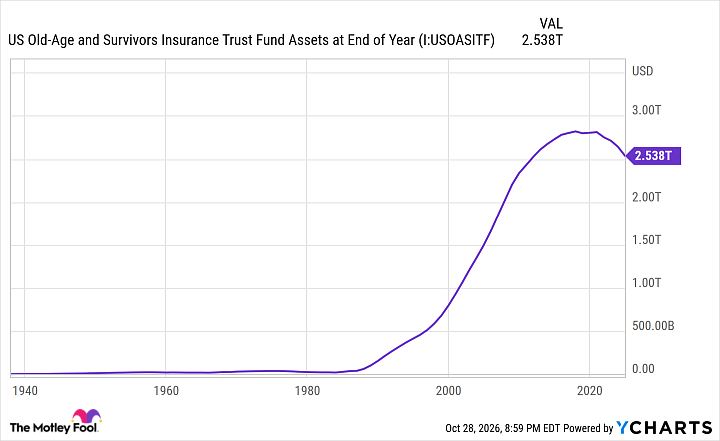
Old Age and Survivors Insurance Trust Fund Assets in the United States, Year-End Data by YCharts
On the one hand, the AVS does not need a penny in its asset reserves to continue making its payments. The way Social Security is financed, with a 12.4 percent payroll tax on earned income generating more than 91 percent of the program’s revenue, ensures that it cannot go bankrupt.
Conversely, if the AVS asset reserves were depleted in six years, as expected, it would confirm that the current payment schedule, including COLAs, is unsustainable. Sweeping benefit cuts, estimated at 22%, would be necessary to maintain benefits in the future.
Although trustees’ estimates of the AVS’s solvency remain fluid, they are based on a long list of variables, including the program’s annual cost-of-living adjustment. The trustees’ report assumes modest annual benefit adjustments. However, the fifth largest COLA in the last 35 years is not modest.
The July 2025 passage of President Trump’s signature tax and spending law, the “Big, Beautiful Bill,” and its negative impact on Social Security have already prompted trustees to move the projected OASI asset reserve depletion date from the first quarter of 2033 to the fourth quarter of 2032 in the latest report.
A second straight year marked by a Trump boost and an above-average COLA threatens to deplete AVS’s wealth reserves even faster than expected. In other words, the time frame for achieving a drastic 22 percent (or more) reduction in benefits for retired workers and survivors of deceased workers could be less than six years.
Gn bussni

